Helping design and engineering professionals discover, evaluate and specify technologies and processes that shorten the design cycle and enable success.


One of the Arcam EBM Spectra H's new features and enhancements cited by GE Additive is an increased build speed of up to 50% compared with current EBM machines. This, the company explains, is in part due to a 6kW HV-unit beam that reduces all pre- and post-heating steps. Additionally, heat management has been improved through the incorporation of a movable heat shield that keeps heat in the build area.
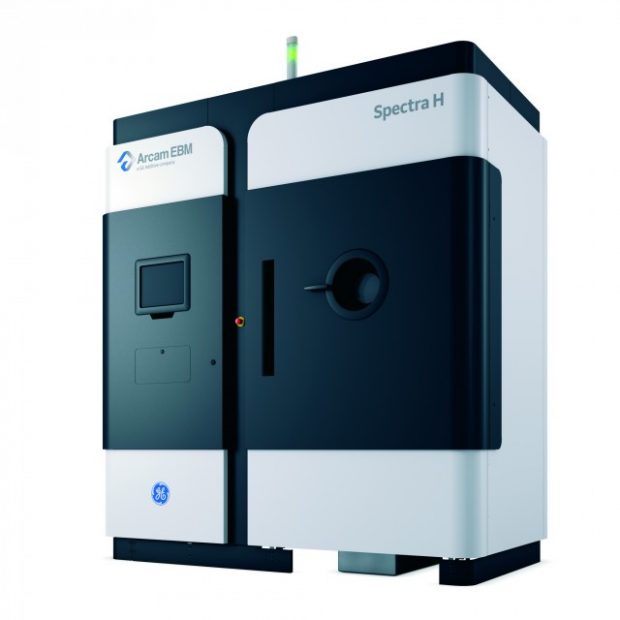 The Arcam EBM Spectra H electron beam melting (EBM) metal additive manufacturing system is designed to handle high heat and crack-prone materials including titanium aluminide and nickel Alloy 718. Image courtesy of GE Additive.
The Arcam EBM Spectra H delivers a 9.84x16.9-in. (250x430 mm) build volume, which is approximately 39% larger than current EBM machines. The company adds that an improved layering procedure reduces the need for heating, saving approximately five hours for a full height build.
The Arcam EBM Spectra H, as well as the company's Qplus EBM systems, will incorporate Arcam xQam automatic calibration technology. This technology, the company says, improves position and focus accuracy, while eliminating the need for manual calibration. The net effect, it explains, is that the process time is reduced from three to four hours to 15 minutes.
The Arcam EBM Spectra H provides a dust-tight environment in all steps of the process that maintains powder batch integrity, reduces the risk of contamination and protects the operator from the powder. Features of the system include automated, self-dosing sieve and hopper filling station processes, automatic powder hoppers and automated powder recovery. The all-new powder distribution system produces repeatable and reliable parts, according to the company website.
The Arcam EBM Spectra H, which complements the company’s existing line of EBM systems, is available for pre-order. It will be manufactured at Arcam’s facility near Gothenburg, Sweden. Shipments are expected to begin in the fourth quarter of 2018, according to the company.
Initially, the Arcam EBM Spectra H will support both TiAl and nickel Alloy 718 materials. The company adds that it plans to offer additional nickel-based superalloys in 2019. GE Additive also reports that its materials science team is currently exploring future opportunities for a wider range of high-heat materials, including nickel superalloys, tungsten, cobalt-chromium, stainless steel and metal matrix composites.
“This new system shows our commitment to developing industry-leading additive machines, materials and services,” said Jason Oliver President and CEO, GE Additive, in a press statement. “We remain focused on accelerating innovation across sectors and helping the world work smarter, faster and more efficiently.”
For more details on the Arcam EBM Spectra H additive manufacturing system, click here.
Watch the Arcam EBM Spectra H introductory video.
See how the Arcam EBM Spectra H's additive manufacturing process works.
Read more about Arcam's materials.
See why DE's editors selected the Arcam EBM Spectra H as their Pick of the Week.
Sources: Press materials received from the company and additional information gleaned from the company's website.


Anthony J. Lockwood is Digital Engineering's founding editor. He is now retired. Contact him via [email protected].
Follow DE
Join over 90,000 engineering professionals who get fresh engineering news as soon as it is published.






About Us · Contact Us · Editorial Team · Advertising · Privacy Policy · Subscriber Services · © 2026 Digital Engineering 24/7 · Peerless Media