Helping design and engineering professionals discover, evaluate and specify technologies and processes that shorten the design cycle and enable success.



Digital Engineering April 2026
In the latest issue of Digital Engineering, we take a look at the latest innovations in design for additive manufacturing, including the use of natural language inputs, social media cosplayers, and AI integration. The issue also includes a feature…

January Special Focus Issue: Design for Additive
In this Special Focus Issue of Digital Engineering, learn about the latest advancements in design for additive manufacturing, including new software tools, additive in automotive, custom medical devices, and more.
A 25-year veteran of the construction business, Rudenko looked at additive manufacturing (AM) and wondered just how hard it would be to construct houses using the technology. So, like many other Maker-type hobbyist researchers, he began by basing his design on the ubiquitous RepRap model. The big difference between Rudenko’s project and a cobbled-together 3D printer was the extruder head, which had to extrude concrete.
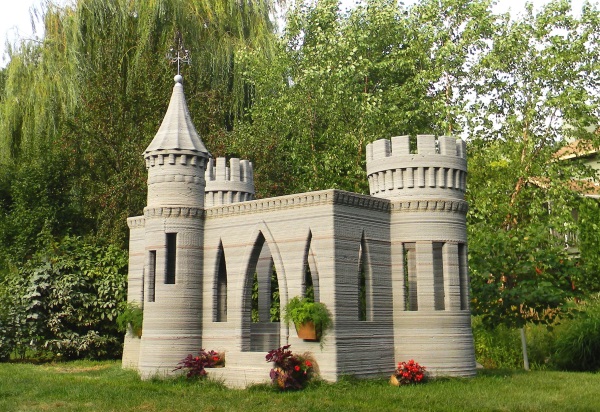
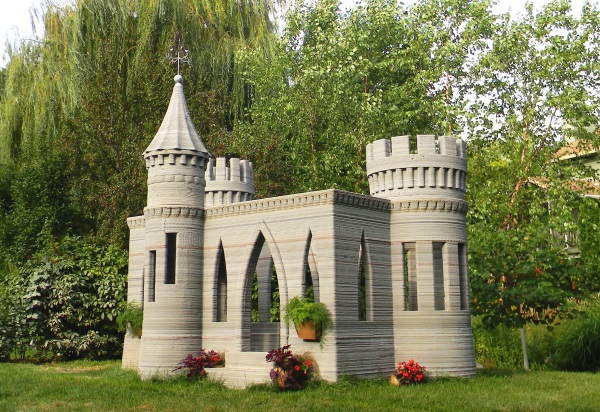 The perfect castle in miniature, and built thanks to 3D printing. Courtesy of Andrey Rudenko.
“It’s really really difficult to extrude cement mix or concrete,” he told Motherboard. “It doesn’t like to be extruded.” Rudenko worked on perfecting the extruder head design for around a year, and then had to discover the right cement mix. He required a mix that would flow smoothly through the extruder head, yet still maintain its shape well enough while wet to ensure it set properly.
With all the technical challenges sorted, Rudenko began to print his proof-of-concept in his backyard. The result might not be Minnesota’s first castle, but it’s certainly the state’s first structure built by AM. The 3D printed castle is just about the right size for a playhouse. The inventor’s next tasks will be selling his idea to investors, and obtaining permits to build larger structures. From his website:
For my next project, I plan on printing the entire structure day and night without stopping, again weather permitting. During nonstop printing the layers turn out very even, all defects and imperfections on the castle happened when I stopped and started the print. Given the success of the preliminary testing, I am now fully convinced that I am ready to print a medium-sized house.
With his castle in place, Rudenko joins the ranks of those who believe the future of construction includes AM. A printer in China has been hard at work proving the concept is possible. Temporary living structures in Shanghai are the result of 3D printing, and a number of companies in the US are also on the case.
Below you’ll find a video about Rudenko’s building process.
Sources: Motherboard, Castle by 3D Printer


John Newman is a Digital Engineering contributor who focuses on 3D printing. Contact him via [email protected] and read his posts on Rapid Ready Technology.
Follow DE
Join over 90,000 engineering professionals who get fresh engineering news as soon as it is published.






About Us · Contact Us · Editorial Team · Advertising · Privacy Policy · Subscriber Services · © 2026 Digital Engineering 24/7 · Peerless Media