Helping design and engineering professionals discover, evaluate and specify technologies and processes that shorten the design cycle and enable success.




Digital Engineering April 2026
In the latest issue of Digital Engineering, we take a look at the latest innovations in design for additive manufacturing, including the use of natural language inputs, social media cosplayers, and AI integration. The issue also includes a feature…

January Special Focus Issue: Design for Additive
In this Special Focus Issue of Digital Engineering, learn about the latest advancements in design for additive manufacturing, including new software tools, additive in automotive, custom medical devices, and more.
3D printed missiles are exactly what Raytheon has in mind. The company is investigating implementing AM for the same reasons as most other companies, regardless of industry: cost and speed. Designs can be generated and tested with AM in a fraction of the time required by traditional manufacturing methods. A reduction in time to market is also a reduction in cost.
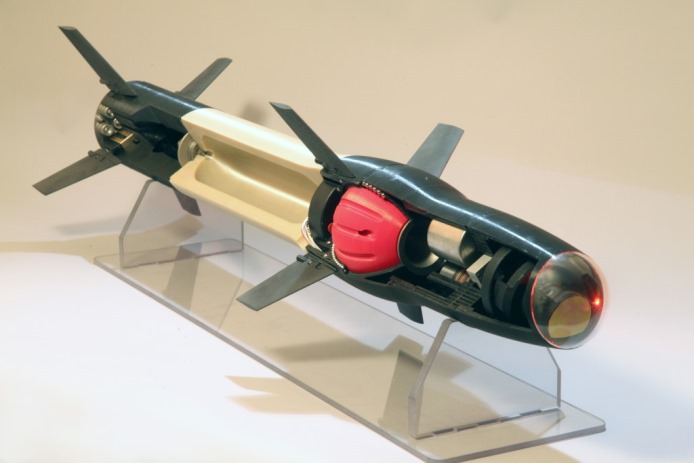 Cutaway of a small missile manufactured by Raytheon. Courtesy of Raytheon.
AM also brings with it a freedom of design that might be inspiring to the engineers at a company with a history as long as Raytheon. After 90 years in the business, bringing in something new to shake up the status quo can invigorate innovation.
“You can design internal features that might be impossible to machine,” said Raytheon engineer Travis Mayberry, who is researching future uses of additive manufacturing and 3D printing. “We’re trying new designs for thermal improvements and lightweight structures, things we couldn’t achieve with any other manufacturing method.”
Raytheon’s research team has already proven it can build the majority of a missile using AM alone. This includes rocket engines, fins, parts for the guidance and control systems, and any necessary circuitry. Ensuring consistent quality is the next, and possibly most important, step on the road to printing a missile.
Just because you can do something doesn’t mean you should. Why 3D print a missile? Other than reducing cost, the ability to build missiles in the field would give flight crews additional flexibility in the type of munitions to be used. In much the same way that artillery crews can load their weapons for specific tasks, flight crews could build missiles to perform in a specific manner, thus increasing effectiveness.
Below you’ll find a video about Raytheon.
Source: Raytheon


John Newman is a Digital Engineering contributor who focuses on 3D printing. Contact him via [email protected] and read his posts on Rapid Ready Technology.
Follow DE
Join over 90,000 engineering professionals who get fresh engineering news as soon as it is published.






About Us · Contact Us · Editorial Team · Advertising · Privacy Policy · Subscriber Services · © 2026 Digital Engineering 24/7 · Peerless Media