Helping design and engineering professionals discover, evaluate and specify technologies and processes that shorten the design cycle and enable success.


Alert!
Digital Engineering ceased publication on July 1, 2026. This website remains available as an archive of engineering content.
For inquiries or information, please email [email protected].

May 2026 Special Focus: Artificial Intelligence in Design and Simulation
In this Special Focus Issue, learn about the latest developments in the integration of artificial intelligence into engineering workflows.

Design & Simulation Software Guide 2025
In this Special Issue, Digital Engineering presents its second annual guide to design and simulation software vendors.
Sometimes the most commonplace technologies have the most esoteric physics. That'sthe assessment of Paul Lethbridge, ANSYS vice president for product development.And while we're not talking rocket science, they're involved in some rather intriguingdown-to-earth projects. Lethbridge says the most interesting technology he's workedwith recently involves the CTS Cadillac, which is fitted with "shock absorbersusing damper technology based on ferrofluidic devices: basically a fluid thatchanges viscosity based on magnetic fields." 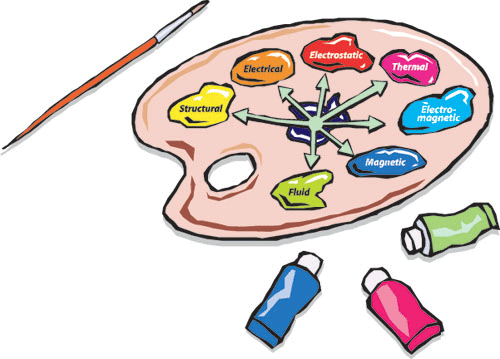
GM's magnetic selective ride control uses electromagnetically charged particlessuspended in shock fluid. When a magnetic field surrounding the shock absorberis activated, the fluid properties change to a near-solid state. Each wheel hasposition sensors that send real-time road condition information to a controllerand the system responds by hardening or liquifying the fluid; you can even chooseTour or Sport responsiveness. Thus, the designers need to analyze fluids, solids,and electromagnetics as a single system.
From catheters to circuit breakers and from microphones to MEMS (microelectromechanicalsystems), many of today's design challenges require evaluating not only more thanone aspect of physics, but also coupled, and often interdependent, phenomena.For users accustomed to doing just structural FEA (finite element analysis), thiscan mean stepping up to incorporate thermal, fluidic, and various electromagneticbehaviors in their design analyses. (See "Multiphysics Marvels," below.)
|
Multiphysics Marvels |
|
|
Problem Type Thermal-Structural |
Example Application Gas turbine |
Multiphysics analysis is a powerful approach that is becoming easier to applydue to improvements in offering a single, improved-GUI software environment withoutthe need for neutral file data exchange. Where it used to take almost handcraftingto format the results from one simulation as input for another, today's productsare tightly integrated. To find out just where multiphysics currently stands,we asked a number of developers to tell us what to look for, what to expect, andwhy analysts should buy into the technology.
ABAQUS heat-transfer capabilities, contact, and user subroutines facilitate complexsimulations, such as this application from Honeywell involving coupled carbonresistance heating in a vacuum between contacting bodies for electronics
packaging soldering.
Fundamental Physics at Work
One of the more common tasks asked of multiphysics software involves fluid-solidinteraction (FSI), the analysis of which takes place in many aspects of automotiveand aerospace design. But biotechnology engineers are using it too in productssuch as hydraulically steered intravenous catheters. And developing the newestMEMS devices can require even more combinations, integrating thermal, structural,fluidic, and electrostatic computations. Add transient issues such as changesin temperature, airflow, and electrostatics as optical or electronic parts heatup, and you have some complicated physics at work.
 ABAQUS heat-transfer capabilities, contact, and user subroutines facilitate complexsimulations, such as this application from Honeywell involving coupled carbonresistance heating in a vacuum between contacting bodies for electronics packingsoldering.
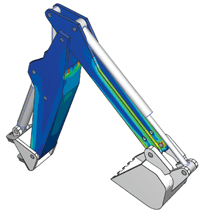 solution. Paul Lethbridge at ANSYS cautions that a successful process must particularlymonitor the convergence at the interface where loads are transferred.
UGS Director of Marketing Don Tolle agrees that bidirectional capabilities areimportant. "This enables the user to make design changes without having to manuallyset up boundary conditions when moving from one analysis domain to another (e.g.,NX TMG thermal results mapped as a load case onto an NX Nastran structural analysis).
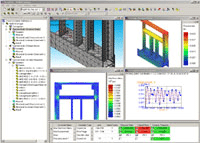 This comparative analysis inside 3G.author from PlassoTech looks at the thermalstress and dynamic response of an assembly structure with weldings. Accuracy ofthe mesh is helped by using automated adaptive techniques, a key when differentanalyses are concerned.
However, there are scenarios where it's difficult to efficiently write the combineddifferential equations that have all coefficients in one matrix. In these cases,you solve two matrices (performing sequential multiphysics) and "add" the results.This is the traditional staggered or cosimulated approach, where you pass theresults of one analysis as a load vector to the next.
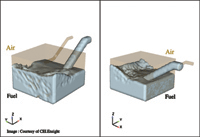 Ever-shrinking gas-tank spaces in new vehicles must still handle effects likepremature gas-pump switch-off or backsplashing. MSC.Marc uses Multiple AdaptiveEuler Domains for Multiple Material when simulating and analyzing a fuel tankwith a filling pipe and a vent pipe, accommodating the multiphysics aspects ofair and fuel. Image courtesy MSC.Software.
 A fluid-solid coupled analysis of a gas turbine blade performed using CFX-5.7and ANSYS Multiphysics. Pressure and temperature CFD results (left) are passedto and incorporated into the structural analysis (right), where resultant displacements,stress (far right), and structural temperature are computed.
What Customers Want
ESI Group knows its customers want analyses that run in one environment, areeasy to use, and can incorporate new robust capabilities. Louis Doggett, Jr.,ESI's director of worldwide CFD sales and marketing, notes that ESI software alreadyhandles multidimensional (0D-3D) problems in steady or transient form in suchapplications as multiphase flow, FSI, and plasmas.
Other customer questions are: Can the software do linear as well as nonlinearanalysis within a single run? Can it handle higher physics, such as acoustic-structureinteractions or piezoelectric behavior? Do the analyses attain equilibrium atthe same time? Is there a limit to problem size? Is the material property databasecommon to all analysis types? What are the hardware (CPU, memory) requirements?How steep is the learning curve?
ALGOR developers suggest two more questions: Can the package directly exchangedata with all the solid modeling tools you might be using? Are there adequatefeatures for evaluating and presenting analysis results?
Bidirectional Coupling—
|
ANSYS's Lethbridge says these days the software is very much user-driven as opposedto technology-driven. To illustrate, he says the company is migrating the powerof its traditional core physics into its newer, unified Workbench environment,though users can still write macro-scripts to tailor their applications.
Lastly, not everyone wants to or can use the predetermined parts of packages.Tim Niu at COMSOL explains that its software lets you specify physical propertiesas analytical expressions or functions, so that you are not constrained to ready-madecapabilities. Users can input arbitrary partial differential equations to extendthe range of applications, and can define coupling needs, including three or more,in a single model.
Most vendors agree on the best advantages of using multiphysics software:
|
|
Left: Thermal performance of a heat exchanger using a fluid cooling medium canbe optimized using I-deas NX Electronic System Cooling. |
|
|
|
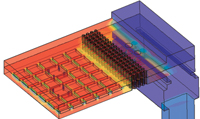
Left: 3D coupled thermal/flow simulation capabilities within I-deas NX seriesfrom UGS enables engineers to optimize the cooling air flow required in denselypacked consumer electronics enclosures such as personal computers.
|
Which Way to Future Multiphysics?
As always, the better you understand your own needs, the better fit you can findin software. Dale Berry, manager of engineering applications at ABAQUS, pointsout that "although tight integration is a benefit, it often comes at the expenseof modeling and solution capability. Often, the tightly integrated solutions aremore limited in each domain than separate packages."
As for the future, Reza Sadeghi at MSC.Soft- ware muses, "Will a fluids companylead this, or ]will] a structures company? As long as the manufacturing worldhas experts and specialties and departments, they'll continue to start from oneend and demand capabilities to be added to that particular discipline. At somepoint in the future, one can imagine we will be able to do it all—letting fluidsdominate or structures dominate—and ask all the questions from the same analysis,but there's time to get there."
Contributing editor Pamela J. Waterman is an electrical engineer and a freelancetechnical writer based in Arizona. You can contact her about this article viae-mail c/o [email protected].
Companies mentioned in the article:
ABAQUS, Inc.
Pawtucket, RI
abaqus.com
ALGOR, Inc.
Pittsburgh, PA
algor.com
ANSYS, Inc.
Canonsburg, PA
ansys.com
COMSOL, Inc.
Burlington, MA
comsol.com
ESI-Group, Inc.
Bloomfield Hills, MI
esi-group.com
MSC.Software Corp.
Santa Ana, CA
mscsoftware.com
Noran Engineering, Inc.
Westminster, CA
nenastran.com
PlassoTech, Inc.
Encino, CA
plassotech.com
Structural Research and Analysis Corp.
Los Angeles, CA
srac.com
UGS Corp.
Plano, TX
ugs.com
FEA Provider Product Listing
|
ABAQUS |
ALGOR Design and Analysis Software |
DesignCheck bundled with Alibre Design Professionaland Alibre Design Expert |
|
ANSYS 9.0
ANSYS Inc.
ansys.com |
FEMLAB 3 |
NISA II, ENDURE |
|
StressCheck |
CATIA V5
|
KELVIN |
|
Moldflow Plastics Advisors |
SimDesigner |
NEiNastran NEiWorks
|
|
COSMOSMotion 2005COSMOSFloWorks 2005COSMOSWorks 2005 |
||
|
WinTherm |
NX Digital Simulation |

ESRD is engaged in the development of advanced engineering software products and offers professional services in areas pertaining to numerical simulation in the fields of mechanical, aerospace and structural engineering. ESRD's flagship…

Digital Engineering May 2018
The technology associated with cryptocurrency offers new approaches to data security and transaction record integrity. Learn more about bitcoin and blockchain, a review of AutoCAD 2019 and Lenovo ThinkPad P71, a look into the ESRD CAE Handbook and EMI simulation advances.

Pamela Waterman worked as Digital Engineering's contributing editor for two decades. Contact her via DE-Editors@ digitaleng.news.
Follow DE






About Us · Contact Us · Editorial Team · Advertising · Privacy Policy · Subscriber Services · © 2026 Digital Engineering 24/7 · Peerless Media