Helping design and engineering professionals discover, evaluate and specify technologies and processes that shorten the design cycle and enable success.



May 2026 Special Focus: Artificial Intelligence in Design and Simulation
In this Special Focus Issue, learn about the latest developments in the integration of artificial intelligence into engineering workflows.

April 2026 Special Focus Issue: Generative Design
In this Special Focus Issue, Digital Engineering takes a look at how generative design solutions can be used across different types of design problems and with a variety of manufacturing approaches to accelerate design space exploration, and…
Nanotronics Imaging may not be the type of company one might normally associate with 3D printing. The company designs and produces computer-controlled microscopes able to view down to nanoscale. Rather than just using AM for prototyping, the company may be the first laboratory equipment provider to offer a 3D printed microscope.
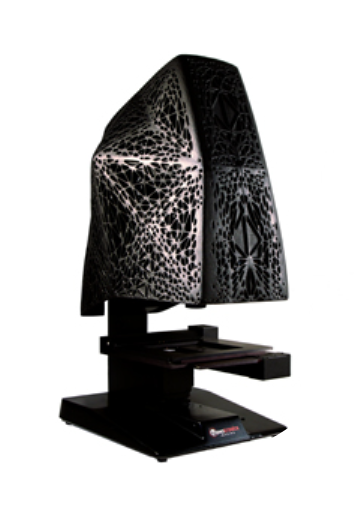 The nSpec 3D features 3D printed construction along with its high tech imaging technology. Courtesy of Nanotronics Imaging.
According to Nanotronics’ website, the new nSpec 3D is “an automated, rapid optical microscope that provides surface topographies and quantitative roughness measurements.”
The microscope has been designed to offer industries such as tire, medical device, steel, battery, aerospace and automotive a new method of inspecting for quality by using high quality optics to capture topography at the nano level. The system has been designed for ease of use as well as for quality results, including features that allow users to begin a scan with the touch of a button, according to the company.
“Our solution will allow a host of industries, including industrial materials, semiconductors, and even biopharmaceuticals, to access sophisticated imaging that can improve their ability to produce and manipulate advanced materials quickly and efficiently,” said Nanotronics Imaging CEO Matthew Putman.
All of that is very impressive, and probably in ways this editor doesn’t quite grasp, but what caught Rapid Ready Tech’s attention wasn’t solely the capabilities of the microscope, but how it was produced. Nanotronics called in New York designers Mari Kussman and Francis Bitonti, who developed a 3D printed casing that is both aesthetically pleasing and functionally robust.
The case is a perfect example of the strengths of AM, namely freedom of design, and the potential for weight reduction without sacrificing durability. As AM continues to evolve and production speed catches up with traditional methods of manufacturing, it seems reasonable to assume we’ll see more 3D printed products offered by an increasing number of different businesses.
Below you’ll find a video about Nanotronics Imaging.
Sources: Nanotronics Imaging, AZoNano


John Newman is a Digital Engineering contributor who focuses on 3D printing. Contact him via [email protected] and read his posts on Rapid Ready Technology.
Follow DE
Join over 90,000 engineering professionals who get fresh engineering news as soon as it is published.






About Us · Contact Us · Editorial Team · Advertising · Privacy Policy · Subscriber Services · © 2026 Digital Engineering 24/7 · Peerless Media