Helping design and engineering professionals discover, evaluate and specify technologies and processes that shorten the design cycle and enable success.



Digital Engineering April 2026
In the latest issue of Digital Engineering, we take a look at the latest innovations in design for additive manufacturing, including the use of natural language inputs, social media cosplayers, and AI integration. The issue also includes a feature…

January Special Focus Issue: Design for Additive
In this Special Focus Issue of Digital Engineering, learn about the latest advancements in design for additive manufacturing, including new software tools, additive in automotive, custom medical devices, and more.
With 4D printing, objects can be squashed down in size by varying the density of the object and building an object out of multiple smaller parts. This allows for objects to be build that far exceed the size of the print envelope. Until recently, 4D printing has mainly been an exercise in theory, but a company named Nervous System has brought the process out of the lab and into retail space.
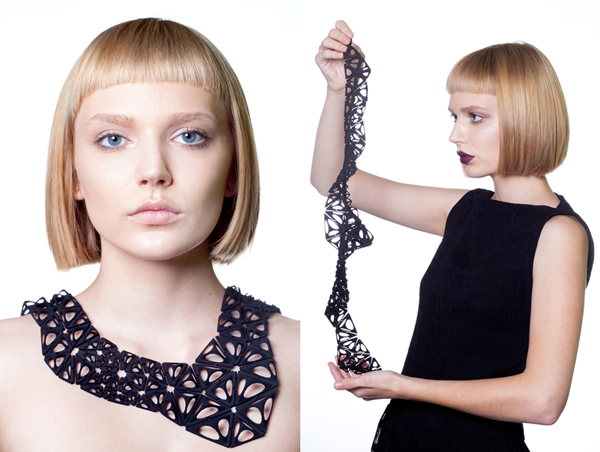
Nervous System was launched by Jessica Rosenkrantz and Jesse Louis-Rosenberg, both graduates of MIT. When the company founders speak you can hear the echoes of Neri Oxman, leader of the school’s mediated matter group in the MIT Media Lab. Nervous Systems draws inspiration from nature to compliment CAD design for 4D printing, which the company refers to as “Kinematics.”
From the website:
Formally we are attracted to complex and unconventional geometries. Our inspirations are grounded in the natural forms and corresponding processes which construct the world around us. From coral aggregations to interference patterns, a study of natural phenomena is an essential ingredient to our design process.To evolve such forms, we systematically engage in generative processes. Instead of designing a specific form, we craft a system whose result is a myriad of distinct creations. These systems are interactive, responding both to changes in specific variables and to physical inputs. There is no definitive, final product, instead the many designs created allow for mass customization.
Rather than apply AM and Kinematics to the production of large-scale objects, Nervous System has instead turned to manufacturing jewelry, puzzles, and other, smaller, objects. This allows the company to create bespoke items that are even more customizable than is normally true for 3D printed products. The addition of 4D printing expands both the size of objects offered, and the possibilities for appearance.
Users can personalize products even further by using a deceptively simple design suite to build their own jewelry. The design application operates on the basic principles of the generative process and includes a tutorial for first time users, the majority of whom will never realize the complexity of the program that just made them a new bracelet.
Below you’ll find a couple videos. The first is a brief overview of Kinematics, and the second is a quick look at Nervous System.
Source: Nervous System


John Newman is a Digital Engineering contributor who focuses on 3D printing. Contact him via [email protected] and read his posts on Rapid Ready Technology.
Follow DE
Join over 90,000 engineering professionals who get fresh engineering news as soon as it is published.






About Us · Contact Us · Editorial Team · Advertising · Privacy Policy · Subscriber Services · © 2026 Digital Engineering 24/7 · Peerless Media