Helping design and engineering professionals discover, evaluate and specify technologies and processes that shorten the design cycle and enable success.


Alert!
Digital Engineering ceased publication on July 1, 2026. This website remains available as an archive of engineering content.
For inquiries or information, please email [email protected].

Digital Engineering April 2026
In the latest issue of Digital Engineering, we take a look at the latest innovations in design for additive manufacturing, including the use of natural language inputs, social media cosplayers, and AI integration. The issue also includes a feature…

January Special Focus Issue: Design for Additive
In this Special Focus Issue of Digital Engineering, learn about the latest advancements in design for additive manufacturing, including new software tools, additive in automotive, custom medical devices, and more.
OPEN MIND Technologies AG has introduced hyperMILL 2019.2, a new version of its advanced, comprehensive CAD/CAM software suite. The latest hyperMILL software has a range of new features including high-precision 3D finishing, 5-axis tangent machining, high-performance turning and new CAD-for-CAM technologies.
"We are pleased to offer our CAM customers with even more powerful finishing, 5-Axis and turning strategies," says Alan Levine, managing director of OPEN MIND Technologies USA, Inc. "In addition, we have improved programming process times, and have also integrated CAD utilities directly into some CAM strategies."
When using the 3D shape Z-level finishing cycle, hyperMILL 2019.2 now offers a “high precision surface mode” option that ensures ultra-smooth surfaces with tolerances in the micron range. The “Smooth overlap” function also improves surface finish and is available in many cycles. The transition regions for steep and shallow machining have a small overlap including a slightly lifted cutter.
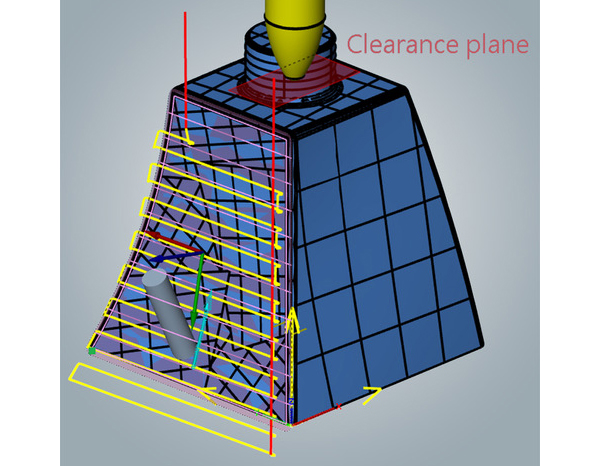
In hyperMILL 2019.2, the hyperCAD-S “Global fitting” function is directly integrated into the CAM strategy for 5-axis tangent machining. With this function, multiple faces can be joined into one face with a controlled ISO orientation. The principle of using CAD elements for CAM programming is also applied for example, to an automatic face extension where the bounding surfaces are automatically extended during programming in an effort to improve the edges of the machined surfaces, the company reports.
In the previous version of hyperMILL MAXX Machining, turn-roughing was implemented with trochoidal toolpaths. Now version 2019.2 offers more process reliability for high-performance turning by providing tool life monitoring, which restricts tool use by the distance covered, the number of toolpaths or a time limit. If the defined limit is reached, a retract macro is generated automatically and the job ends.
OPEN MIND has further enhanced its feature and macro technology in the new version to enable more secure and simpler programming. Full-text searching is now available in the macro database and users can define machine and material groups as defaults to make it easier to select macros.
Hole feature linking enables CAD feature model changes to automatically transfer to hyperMILL. Since design changes in CAD are associatively linked with the CAM, users can quickly and securely make updates.
The hyperCAD-S calculates the workpiece mass and center of mass with a material definition including for solid, mesh and stock models. Also, the “Undercut” function makes it possible to detect undercut areas on components quickly and reliably. In addition, the new “local curvature” analysis function makes it possible to detect curvature radii on components. The minimum curvature radius, which often plays the biggest role, is output immediately, and the best possible lead angles or tool radii for machining curved faces can be determined.
Sources: Press materials received from the company and additional information gleaned from the company’s website.

OPEN MIND offers a CAD/CAM solution whose CAD functionalities are linked to CAM programming.

DE's editors contribute news and new product announcements to Digital Engineering. Press releases may be sent to them via [email protected].
Follow DE






About Us · Contact Us · Editorial Team · Advertising · Privacy Policy · Subscriber Services · © 2026 Digital Engineering 24/7 · Peerless Media