Helping design and engineering professionals discover, evaluate and specify technologies and processes that shorten the design cycle and enable success.



Digital Engineering April 2026
In the latest issue of Digital Engineering, we take a look at the latest innovations in design for additive manufacturing, including the use of natural language inputs, social media cosplayers, and AI integration. The issue also includes a feature…

January Special Focus Issue: Design for Additive
In this Special Focus Issue of Digital Engineering, learn about the latest advancements in design for additive manufacturing, including new software tools, additive in automotive, custom medical devices, and more.
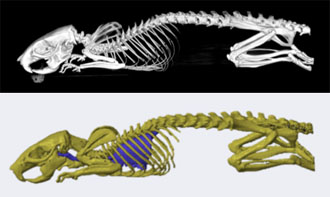
Researchers at Notre Dame have developed a technique using CT scans to produce 3D printed skeletons of animals, along with “pop-out” organs inside the skeletons to provide students and researchers with an up-close look at anatomy. Unlike 3D images displayed on a 2D interface, an AM created skeleton provides hands on applications without requiring dissection.
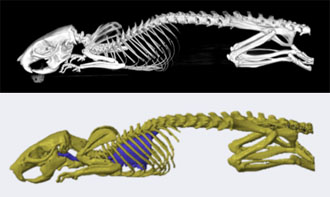
The idea for this approach came from engineering student Evan Doney. Using freeware, Doney converted data from CT scans to language that could be understood by a 3D printer. Upon receiving approval, he printed out several proof of concept skeletons, including a rabbit skull.
Plenty of companies already produce artificial skeletons, but this particular effort went a step further by including specific soft tissue objects that could be fitted inside the skeletons, creating a sort of jigsaw puzzle of whatever animal had been scanned. Organs are color coded to further enhance the educational value of the models.
Another bonus is the cost involved. While AM isn’t necessarily cheap, a small 3D printed skull (for example) that could be taken home for further study by a student costs far less than other manufactured models. Additionally, 3D printed bones could actually end up being more accurate than other models owing to the ability of printers to create more complex geometries than is standard with other methods.
A paper on the project titled “3D Printing of Preclinical X-ray Computed Tomographic Data Sets” was published at the online scientific journal Jove.
Printing bones has become quite the thing lately. Rapid Ready recently covered a story about 3D printed prosthetic skulls. Below you’ll find a video about a procedure that used the prosthetic to replace 75% of a patient’s skull.
Source: Wired


John Newman is a Digital Engineering contributor who focuses on 3D printing. Contact him via [email protected] and read his posts on Rapid Ready Technology.
Follow DE
Join over 90,000 engineering professionals who get fresh engineering news as soon as it is published.






About Us · Contact Us · Editorial Team · Advertising · Privacy Policy · Subscriber Services · © 2026 Digital Engineering 24/7 · Peerless Media