Helping design and engineering professionals discover, evaluate and specify technologies and processes that shorten the design cycle and enable success.



May 2026 Special Focus: Artificial Intelligence in Design and Simulation
In this Special Focus Issue, learn about the latest developments in the integration of artificial intelligence into engineering workflows.

April 2026 Special Focus Issue: Generative Design
In this Special Focus Issue, Digital Engineering takes a look at how generative design solutions can be used across different types of design problems and with a variety of manufacturing approaches to accelerate design space exploration, and…
In this third major update of nTopology, the company is introducing GPU acceleration for seamless interactivity, nTopology notes. By enabling this new opt-in feature, nTop users will have an instant erformance boost when visualizing workflows that use complex field-driven geometry, according to nTopology. Users can reportedly preview design changes in real time and regenerate parts with complex geometry in seconds.
nTopology 3.0 also consolidates the incremental technology improvements introduced to the software over the past few months. These include functional latticing workflows, topology optimization tools, expanded engineering simulation utilities and advanced design automation capabilities.
Existing users can access all new functionality by updating to the latest version of the software. If you want to experience the power of nTopology on your screen, download the software for an interactive preview of common nTop applications—or activate a full-featured trial—by creating a free nTop account.
Following is a dive into the main features of nTopology 3.0 and how these changes may impact your work. For a technical overview, check out the release notes.
At the core of nTopology is its implicit modeling engine. In implicit modeling, every solid body is described by a single mathematical equation. This representation enables users to generate complex part geometry without error, the company says.
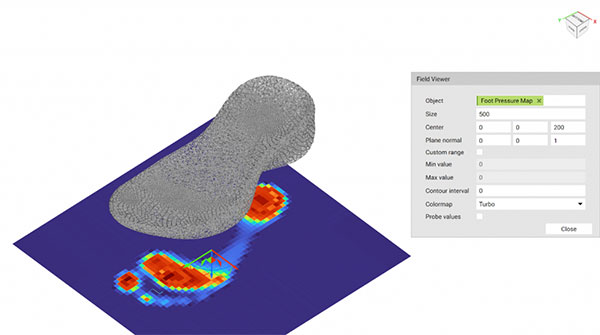
With GPU acceleration, interacting with complex designs in nTopology becomes seamless, according to nTopology, enhancing the connection between the designer and the software.
Through its technology, nTopology can now use the CPU and GPU of a system. As a result, latticing, texturing, filleting, shelling and other field-driven operations can now be previewed in real time. Complex designs can be rebuilt in a few seconds, the company notes.
With GPU acceleration enabled, users can save time every time they change a design parameter. Real-time feedback delivers more insight into how each design parameter affects the final design. If you are a new user, this means that the time it takes to become proficient with new advanced design concepts can now shrink by an order of magnitude.
Here’s a breakdown of the tools the company has released over the past few months to enhance generative design processes.
Performance-Driven Lattice Generation. Using performance requirements as an input, users can “architect” the material response needed for each specific application. This capability comes in handy when users need to vary the material properties in different sections while using a single manufacturing material. It also pairs well with additive manufacturing processes.
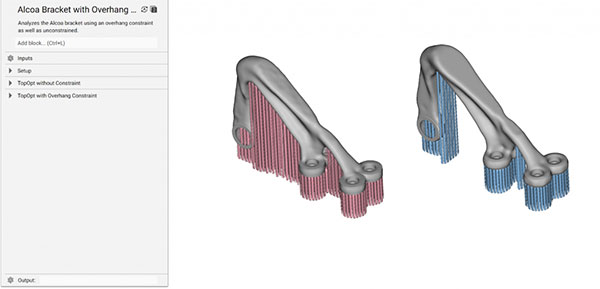
Topology Optimization with Automated Post-Processing. nTopology 3.0 gives access to state-of-the-art algorithms and constraints for additive manufacturing. In nTopology, users design processes, not just parts. Once users create a workflow, users can change its inputs—such as the design space or density threshold—and the whole process will be replayed automatically.
Other tools in the new version focus on Design Automation & MDO Integrations; and Engineering Simulation & Design Analysis.
Visit nTopology's site for more details.
Sources: Press materials received from the company and additional information gleaned from the company’s website.


DE's editors contribute news and new product announcements to Digital Engineering. Press releases may be sent to them via [email protected].
Follow DE
Join over 90,000 engineering professionals who get fresh engineering news as soon as it is published.






About Us · Contact Us · Editorial Team · Advertising · Privacy Policy · Subscriber Services · © 2026 Digital Engineering 24/7 · Peerless Media