Helping design and engineering professionals discover, evaluate and specify technologies and processes that shorten the design cycle and enable success.



May 2026 Special Focus: Artificial Intelligence in Design and Simulation
In this Special Focus Issue, learn about the latest developments in the integration of artificial intelligence into engineering workflows.

April 2026 Special Focus Issue: Generative Design
In this Special Focus Issue, Digital Engineering takes a look at how generative design solutions can be used across different types of design problems and with a variety of manufacturing approaches to accelerate design space exploration, and…
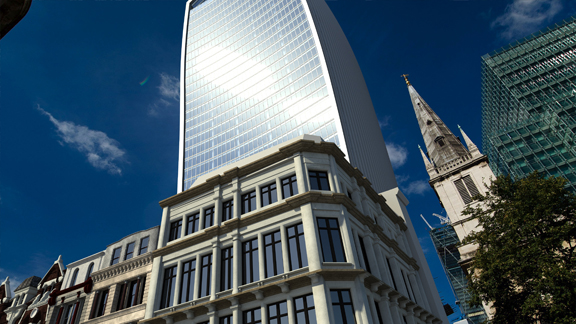 The intensity of the hotspot resulting from reflection from the London Fenchurch Street Tower can be seen in this digital simulation, demonstrated at NVIDIA GTC.
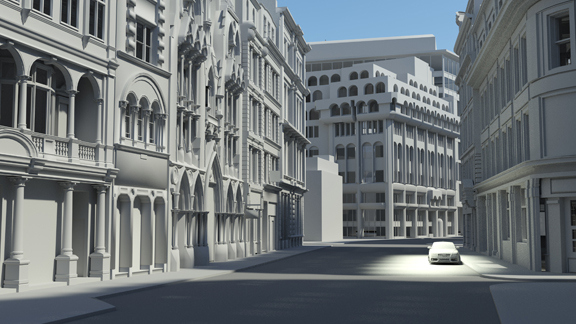 The hotspot created from sun reflection from the Fenchurch Street tower was intense enough to melt a Jaguar, as demonstrated at NVIDIA GTC.
Death ray is not an imaginary phenomenon, not something unleashed from the Death Star in the heat of a galactic battle.
It's a real architectural phenomenon, and can be just as lethal as its fictional counterpart. It's a growing problem associated with the use of concave glass surfaces in highrises.
The Vdara hotel in Las Vegas and the 20 Fenchurch Street tower in London are now cautionary tales for those considering skyscrapers with reflective curved walls. At a certain time of day, the scorching desert sun striking the Vdara's glass wall turned into concentrated solar rays, or death rays, hot enough to cook the guests by the poolside below. The same type of ray emitted from the Fenchurch Street tower was hot enough to melt a Jaguar XJ and fry an egg. The hotspots reflected off the Fenchurch Street tower sizzled up to 140F, according to BBC. Both of these skyscrapers (dubbed "fryscrappers" by some) were designed by architect Rafael Viñoly.
The dangerous solar action could be studied and prevented, if the building designers can accurately simulate the behavior of light in a digital environment. Here, architecture may benefit from an entertainment technology once confined mostly to movies and games.
GPU-accelerated visualizations are generally known for producing stunning eye-candy cinematic sequences and virtual worlds for gamers, but they've evolved into a predictive design tool, especially where light significantly affects the aesthetics and performance of the design. In 2015, NVIDIA's iray software, a physically accurate rendering program, is expected to be incorporated into mainstream 3D modeling programs, including Autodesk 3ds Max, Maya, and Revit.
At NVIDIA GTC, the company demonstrated how the architects might have uncovered the deadly design flaws in the Fenchurch Street tower. Using Autodesk Revit's seasonal sun angle simulation, accelerated on NVIDIA GPU, the designers could have predicted the intensity of the hotspots the curve surface produces. The Lumen values of the hotspot could be translated into temperature, giving the designer an understanding of the dangerous heat level.
In the blog post detailing the demo, Greg Estes, NVIDIA's VP enterprise marketing, pointed out, "In the past, modeling reflected light has been a time-consuming procedure. It’s usually reserved for presentations of near-final designs. And designers build those presentations around specific lighting conditions. They’re snapshots, not simulations."
The time it takes to compute the paths of the individual light rays may be further reduced with a specialized hardware like NVIDIA Quadro VCA (visual computing appliance). Outfitted with an Intel Xeon processor and 8 professional-class GPUs, the appliance can speed up the simulation by breaking it into parallel tasks for the computing cores available. (with 8 Quadro GPUs, it yields roughly 24,500 CUDA cores.)
Beyond architecture, ray-traced rendering has also become the standard approach to communicate design concepts in automotive and aerospace, where physical mockups cost significantly more than digital models. Software giants like Dassault Systemes, a household name in CAD and PLM, envisioned GPU-accelerated visuals delivered from the cloud as the engine behind its 3DEXCITE offerings, developed to let product designers create virtual experiences to appeal to the consumers.
The leap from approximation of light paths to physically accurate ray-traced rendering elevates GPU-based visualization to a tool for verifying and predicting real-world events. The advantage it offers is not just prettier pictures and higher pixel count; it affects the corporate wallet. The proposed fix for the 37-story Fenchurch Street tower -- a series of sunshades -- is estimated to cost in the "single digit million," according to Bloomberg Business. That doesn't include the cost of one melted Jaguar parked in the death ray's path.


Kenneth Wong is Digital Engineering's resident blogger and senior editor. Email him at [email protected] or share your thoughts or suggestions at digitaleng.news/facebook.
Follow DE
Join over 90,000 engineering professionals who get fresh engineering news as soon as it is published.






About Us · Contact Us · Editorial Team · Advertising · Privacy Policy · Subscriber Services · © 2026 Digital Engineering 24/7 · Peerless Media