Helping design and engineering professionals discover, evaluate and specify technologies and processes that shorten the design cycle and enable success.



May 2026 Special Focus: Artificial Intelligence in Design and Simulation
In this Special Focus Issue, learn about the latest developments in the integration of artificial intelligence into engineering workflows.

April 2026 Special Focus Issue: Generative Design
In this Special Focus Issue, Digital Engineering takes a look at how generative design solutions can be used across different types of design problems and with a variety of manufacturing approaches to accelerate design space exploration, and…
When you think of a high performance computing (HPC) system, you might envision a series of rack-mounted servers housed in a climate-controlled room. It’s the parallel-processing Goliath that the entire company relies on for heavy-duty simulation jobs, like finite element analysis (FEA) and computational fluid dynamics (CFD). Now, NVIDIA is introducing what amounts to a mini-HPC system inside a workstation -- Goliath’s enviable strength in David’s nimble form.
Dual GPU Setup
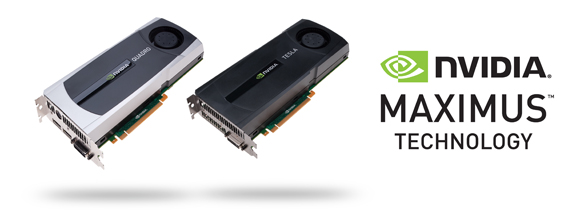
Packed into a standard workstation, NVIDIA’s Maximus technology is expected to let you work in a CAD modeling program, render photorealistic product shots, and run simulation jobs -- all at the same time. Usually, an engineering or design workstation is powered by a multicore CPU and a processional graphics processor (like NVIDIA’s Quadro GPU). In a Maximus machine, however, you get the combined horsepower of a CPU, a Quadro GPU, and a Tesla GPU.
With the ability to dynamically balance computation workload, Maximus workstations are designed to determine and distribute processing jobs to the appropriate processors (for example, delegating interactive CAD modeling to the CPU, OpenGL-powered graphics rendering to Quadro GPU, and CUDA-powered fluid dynamic jobs to Tesla GPU) with little or no intervention from the user.
According to NVIDIA, its hardware partners are on board to begin delivering Maximus workstations equipped with NVIDIA Tesla C2075 GPUs. Earliest units are expected to come from Dell, HP, Lenovo, and Fujitsu. Prices for Maximus workstations are estimated to begin around $8,000 to $10,000.
NVIDIA explains that the Tesla GPU used with Maximus technology is the same ones used for clusters, but its architecture has been slightly modified to fit into a traditional workstation (Tesla units for clusters, for example, use a different cooling technology). To enable easy load balancing and OEM certification, NVIDIA will allow Quadro and Tesla GPUS to run on a unified driver.
Parallel Processing Power for Parallel Design Workflow
In many engineering firms, the HPC system is a monster with a long tail. Because it’s a shared resource used by a pool of engineers and designers, many submitted jobs tend to sit in the system’s queue for a while before they get their turns. The wait, which puts critical design decisions on hold, has become an inevitable part of simulation-driven projects. NVIDIA anticipates that many of these users will look to Maximus workstations’ local HPC-processing power as a way to bring relief to their simulation bottlenecks.
By bringing FEA and CFD processing power back to local machines, NVIDIA offers engineers an ideal multitasking possibility: They can now design their product's geometry in CAD software, evaluate its aesthetics in near real-time rendering mode, and verify its structural integrity and functions through simulation. Previously, engineers could only perform these tasks one at a time, as rendering and simulation tend to consume all the computing cores available in the machine and slow down the unit to a crawl. But with a Maximus-class workstation, engineers may perform all these tasks in parallel -- without suffering from a system slowdown or software performance degradation.
For more, read my guest blog post at NVIDIA's blog and listen to a recorded Q&A with David Watters, NVIDIA's senior director of marketing for manufacturing and design segments.




Kenneth Wong is Digital Engineering's resident blogger and senior editor. Email him at [email protected] or share your thoughts or suggestions at digitaleng.news/facebook.
Follow DE
Join over 90,000 engineering professionals who get fresh engineering news as soon as it is published.






About Us · Contact Us · Editorial Team · Advertising · Privacy Policy · Subscriber Services · © 2026 Digital Engineering 24/7 · Peerless Media