Helping design and engineering professionals discover, evaluate and specify technologies and processes that shorten the design cycle and enable success.




Sponsored

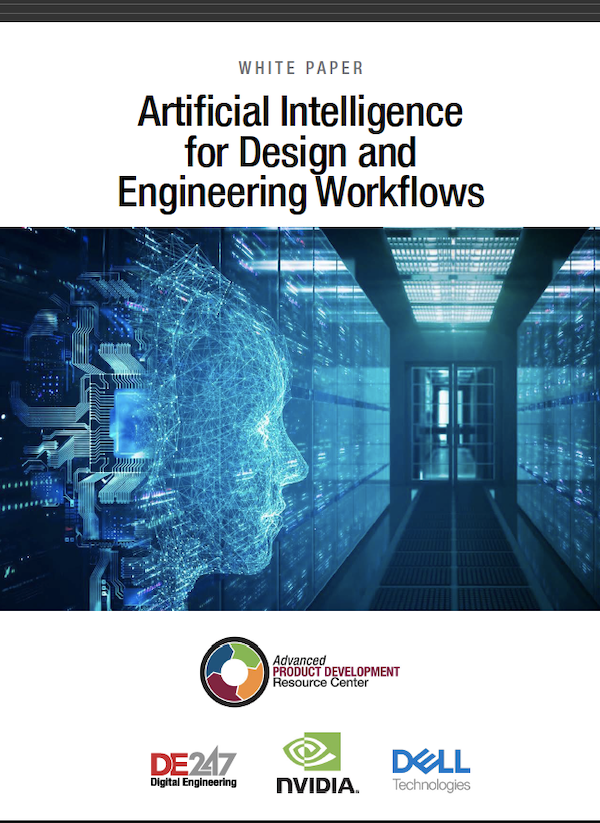
Artificial Intelligence for Design and Engineering Workflows
In this white paper, learn how artificial intelligence and machine learning can improve design and simulation.

Technology Focus: Designing for Optimization & Simulation
Simulation is pervasive, with people from different departments and backgrounds discovering new ways to put it to use, in all of its varied forms.
Earlier this year, NVIDIA announced that it was investing in computational design software provider nTop via its NVentures venture capital subsidiary, as well as collaborating with the company to integrate their software offerings – building on their ongoing partnership around nTop’s platform being optimized to run on NVIDIA RTX™GPUs, and nTop’s participation in the NVIDIA Inception program.
According to the company, nTop’s software automates design and optimization processes while integrating with engineering teams’ existing design, analysis, and simulation tools and workflows. nTop’s integration with NVIDIA RTX professional GPUs allows engineering teams to accelerate product design and engineering workflows.
As part of the new agreement, nTop’s software will be integrated with the NVIDIA OptiX™ rendering framework and NVIDIA Omniverse™ platform, enabling developers to create new features that help engineering teams accelerate and better visualize designs.
NVIDIA Omniverse is a platform of APIs, SDKs, and services that enable developers to integrate Universal Scene Description (OpenUSD) and NVIDIA RTX™ rendering technologies into existing software tools and simulation workflows for building AI systems.
According to the announcement:
“The first proof of concept integrates the NVIDIA OptiX ray-tracing framework to provide more realistic rendering in nTop. Omniverse SDKs and APIs will also be used to integrate nTop implicits into the Omniverse and OpenUSD ecosystem to provide engineering teams an immersive 3D collaboration environment to see and interact with live digital twins of their parts and assemblies. As changes are made to designs in nTop, they can be reflected in OpenUSD applications developed on the Omniverse platform, with no meshing necessary for the transfer.”
nTop is a member of NVIDIA Inception, a program that nurtures startup companies revolutionizing industries with technological advancements. According to Les Karpas, Inception Partner Manager at NVIDIA, the program has 22,000 members globally. Members benefit from discounts on hardware, as well as credits for accessing cloud compute resources. Members also have access to the NVIDIA Deep Learning Institute, the NVIDIA internal training library, and matchmaking portal to connect with venture capital partners.

But the relationship between nTop and NVIDIA stretches back to the early days of the company, says Bradley Rothenberg, co-founder and CEO, nTop. Originally, nTop leveraged parallel processing on CPUs for modeling complex shapes. In 2017, though, the nTop team compiled its core modeling technology on NVIDIA GPUs. “It was this magic moment, because I could take a model like a really complex heat exchanger, and real time I could make edits to the design and see those updates on my screen,” Rothenberg says. “There is a symbiotic relationship between nTop and NVIDIA where the advancements they achieve in GPU and parallel compute have enabled advancements in our 3D solid modeling technology.”
nTop will also be developing a proof of concept through its integration with NVIDIA Omniverse that allows its core models to exist within applications built by developers on the Omniverse platform. When nTop users make changes to a model, it will automatically update the model in a USD-based application built on Omniverse and vice versa. “nTop was one of the first [third-party] Omniverse Connectors,” Karpas says. “If you are doing iterative simulation, nTop can make generative design changes based on the simulation results. It is a very powerful tool.”
NVIDIA has also collaborated with nTop on the use of signed distance fields (SDF) for fast and robust modeling of parts and systems. “If you are doing Boolean Operations in CAD, and taking one geometric solid body and subtracting or adding it to another, it’s important to have these be fully closed, manifold objects,” Karpas says.”This creates a lot of headaches for CAD users when in, in the course of regular modeling, you pierce a mesh and something is not solid. You can waste a lot of time in 3D modeling to enclose those objects. Using a field-based approach, you treat the body not as a solid but more as a cloud of points, and this makes it much easier to subtract and manipulate those bodies. It is also very computationally friendly to GPUs.”
SDFs are being incorporated into the OpenUSD platform.
“OptiX is really the first proof of concept of integrating NVIDIA technology into nTop,” Rothenberg says. “You can render in real time with high-quality materials in nTop, and do so quickly when you are modeling complex parts.”
To learn more about nTop, visit: www.ntop.com.

Dell sells personal computers (PCs), servers, data storage devices, network switches, software, computer peripherals, HDTVs, cameras, printers, MP3 players, and other electronics.
Artificial Intelligence for Design and Engineering Workflows
In this white paper, learn how artificial intelligence and machine learning can improve design and simulation.

Brian Albright is the editorial director of Digital Engineering.
Contact him at [email protected].

Join over 90,000 engineering professionals who get fresh engineering news as soon as it is published.






About Us · Contact Us · Editorial Team · Advertising · Privacy Policy · Subscriber Services · © 2026 Digital Engineering 24/7 · Peerless Media