Helping design and engineering professionals discover, evaluate and specify technologies and processes that shorten the design cycle and enable success.



Digital Engineering April 2026
In the latest issue of Digital Engineering, we take a look at the latest innovations in design for additive manufacturing, including the use of natural language inputs, social media cosplayers, and AI integration. The issue also includes a feature…

January Special Focus Issue: Design for Additive
In this Special Focus Issue of Digital Engineering, learn about the latest advancements in design for additive manufacturing, including new software tools, additive in automotive, custom medical devices, and more.
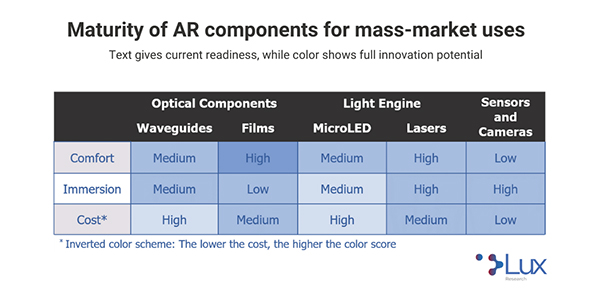
Consumer mass-market augmented reality (AR) products and applications could become the fourth wave of modern technological progress, after the PC and smartphone in transformative impact on nearly all aspects of life and business. However, making widespread consumer AR a reality will require key innovations in areas to reduce size and weight while improving performance, according to new analysis from Lux Research, a provider of tech-enabled research and innovation advisory services.
Lux Research’s new report, “The Hardware and Materials Innovations Enabling Consumer Augmented Reality,” explores the materials and hardware innovations enabling consumer-grade AR glasses and provides guidance on the technologies with the greatest opportunities as well as a timeline of the consumer AR evolution. Among AR hardware components, Lux identified three that offer the most potential for innovations:
“Achieving both comfort and immersion levels at a reasonable cost requires miniaturization of all the components with simultaneous performance improvements,” explains Vladimir Roznyatovskiy, Ph.D., senior analyst at Lux Research and lead author of the report. “Optics, light engines, sensors and batteries take up the largest amount of physical space and, therefore, offer the greatest potential for innovations.”
All basic components for functional and immersive AR headwear are available today, but their maturity varies, with many having significant potential future growth.The transition to consumer AR glasses requires significant innovations in optical components, light engines and sensors to achieve the desired combination of immersion and comfort prior to entering the mass market.
The progress will take several years, depending on the maturity of each of the components and the potential for improvements. The market evolution will be staged, with the release of limited function products like AR smart glasses first and with fully immersive and comfortable AR glasses to follow.
Lux predicts that the adoption of smart glasses with limited functions like notifications, navigation and productivity assistance will begin in the next 1 to 5 years, while fully immersive and slick AR glasses capable of blending the virtual and real worlds will take at least 5 to 7 years. Download the executive summary of the report to learn more.
Sources: Press materials received from the company and additional information gleaned from the company’s website.


DE's editors contribute news and new product announcements to Digital Engineering. Press releases may be sent to them via [email protected].
Follow DE
Join over 90,000 engineering professionals who get fresh engineering news as soon as it is published.






About Us · Contact Us · Editorial Team · Advertising · Privacy Policy · Subscriber Services · © 2026 Digital Engineering 24/7 · Peerless Media