Helping design and engineering professionals discover, evaluate and specify technologies and processes that shorten the design cycle and enable success.


Alert!
Digital Engineering ceased publication on July 1, 2026. This website remains available as an archive of engineering content.
For inquiries or information, please email [email protected].

Digital Engineering April 2026
In the latest issue of Digital Engineering, we take a look at the latest innovations in design for additive manufacturing, including the use of natural language inputs, social media cosplayers, and AI integration. The issue also includes a feature…

January Special Focus Issue: Design for Additive
In this Special Focus Issue of Digital Engineering, learn about the latest advancements in design for additive manufacturing, including new software tools, additive in automotive, custom medical devices, and more.
Although a press might be able to pump out more parts in a shorter time than an AM system, someone still has to assemble those parts. Time saved in production may well be lost in assembly. Printed during a single build, in situ, embedded electronics are an example of how AM can compete with and complement existing manufacturing methods, and Optomec has announced a breakthrough in that field.
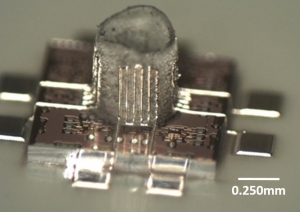 An example of a completed, fully printed dipole antenna microstructure. Courtesy of Optomec.
According to the company, Optomec has developed an improved method of printing at the micron scale using its aerosol jet technology, which allows for printing 3D polymer and composite structures with embedded electronics. Even better, the process works without the need for support structures.
“This breakthrough in 3D printing technology extends additive manufacturing to the creation of micron scale, free-form polymer structures and smart devices,” said Mike O’Reilly, Optomec director of aerosol jet product management. “Early adopter customers have already developed innovative applications for smart devices and micro-fluidic applications. We continue to place emphasis on innovation such as Aerosol Jet 3D micro-structure printing to address our customer’s next generation product development challenges.”
The new process is enabled by a combination of Optomec’s aerosol jet printing, and a proprietary in-situ curing method that enables real-time solidification options. Structures built using the new process can be metalized with conductive traces and may include functional components, such as antennas or sensors. The end result is a fully functional, embedded electronic component.
Optomec claims the process is capable of building structures with lateral feature sizes down to 10 microns, and lateral and vertical build resolutions from 1 micron to 100 nanometers, respectively. Below you’ll find a video from Optomec which demonstrates printed electronics.
Source: Optomec


John Newman is a Digital Engineering contributor who focuses on 3D printing. Contact him via [email protected] and read his posts on Rapid Ready Technology.
Follow DE






About Us · Contact Us · Editorial Team · Advertising · Privacy Policy · Subscriber Services · © 2026 Digital Engineering 24/7 · Peerless Media