Helping design and engineering professionals discover, evaluate and specify technologies and processes that shorten the design cycle and enable success.



Digital Engineering April 2026
In the latest issue of Digital Engineering, we take a look at the latest innovations in design for additive manufacturing, including the use of natural language inputs, social media cosplayers, and AI integration. The issue also includes a feature…

January Special Focus Issue: Design for Additive
In this Special Focus Issue of Digital Engineering, learn about the latest advancements in design for additive manufacturing, including new software tools, additive in automotive, custom medical devices, and more.
One of the major obstacles holding back wider adoption of metal additive manufacturing in industries like automotive and aerospace is inconsistency – the same part printed multiple times on the same printer, or on different printers of the same type, can have varying quality.
This makes it difficult for companies with stringent part performance standards to use the technology. Researchers at Penn State hope to help uncover the source of some of these issues for metal additive manufacturing.
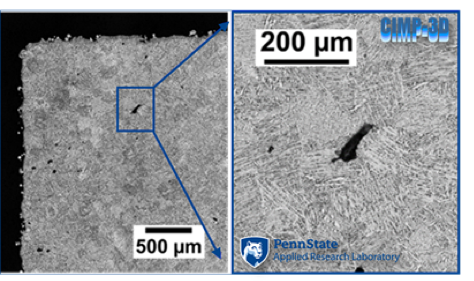
A team working within Penn State’s Applied Research Laboratory in conjunction with the Center for innovative Processing through Direct Digital Deposition (CIMP-3D) has received a $1.4 million grant from the Air Force Research Laboratory (AFRL) to investigate the random flaws that emerge during powder bed fusion AM processes.
Such random flaws can degrade fatigue life and have limited use of the technology in manufacturing. Penn State hopes to develop a better understanding of how these flaws form and how they affect fatigue properties of the finished parts.
The project launched on June 13 at the Maturation of Advanced Manufacturing for Low-Cost Sustainment program Phase 3 Project Call Kickoff Meeting in Columbus, Ohio.
In addition to the academic researchers, several other companies are involved in the project including 3D Systems, Moog, Oerlikon, and the United Technologies Research Center.
According to a press release, the team will “employ high-resolution computed tomography scans and fractographic analysis on pedigreed Ti-6Al-4V fatigue samples in order to quantify the impact of flaws. Additionally, high-speed videos and advanced process sensors will be coupled with process models to gain insight into the phenomena that lead to stochastic flaw formation.”
The award was also part of the America Makes Project Call for Phase 3 of its “Maturation of Advance Manufacturing for Low-Cost Sustainment (MAMLS)” program. Penn State is also participating in a separate project evaluating laser powder bed fusion flaws, that one led by Youngstown State University.
Source: Penn State


Brian Albright is the editorial director of Digital Engineering.
Contact him at [email protected].

Join over 90,000 engineering professionals who get fresh engineering news as soon as it is published.






About Us · Contact Us · Editorial Team · Advertising · Privacy Policy · Subscriber Services · © 2026 Digital Engineering 24/7 · Peerless Media