Helping design and engineering professionals discover, evaluate and specify technologies and processes that shorten the design cycle and enable success.



Digital Engineering April 2026
In the latest issue of Digital Engineering, we take a look at the latest innovations in design for additive manufacturing, including the use of natural language inputs, social media cosplayers, and AI integration. The issue also includes a feature…

January Special Focus Issue: Design for Additive
In this Special Focus Issue of Digital Engineering, learn about the latest advancements in design for additive manufacturing, including new software tools, additive in automotive, custom medical devices, and more.
Unlocking the potential of miniaturization and precision manufacturing could catalyze an array of product advancements, empowering engineers and scientists to challenge the frontiers of innovation in their industries. Virtually every industry stands to benefit from miniaturization, from autonomous vehicles and electronic device gesture recognition to endoscope camera modules, on-body insulin dispensers, and an extensive array of mechanical valves.
Recently, BMF sat down with their customer Quartisis, a micro-printing and machining company specializing in design, machining, 3D printing, rapid prototyping, and expedited delivery of products. Quartisis originally purchased BMF’s microArch S240 in 2022 and has since purchased additional printers.
We met with Quartisis’ Director of Business Development and Quality Engineering, Sheila Ziobro, to learn more about their experience with BMF’s products and how they’re leveraging this technology to rapidly produce parts for their customers.
Sheila: I have a Master’s degree in biomedical engineering, and I’ve spent most of my career working with medical devices. Over this time, I’ve done everything from R&D to quality control. However, I found that the engineering roles were a little too isolating for me and knew I wanted to be in a position where I could work with others. My current role allows me to do that through my work with customers each day. It also taps into my interest in how additive manufacturing can support rapid innovation.
Sheila: In the current economic landscape, speed and responsiveness are critical. Traditional machine shops often require lengthy lead times, sometimes up to 12 weeks. Our approach deviates from this norm. Incorporating 3D printing into our workflow has empowered us to swiftly generate quotes, lining up orders for immediate processing. For instance, during a collaboration with a client, we connected on a Friday and delivered parts by Monday. This agility is a testament to the transformational impact of 3D printing.
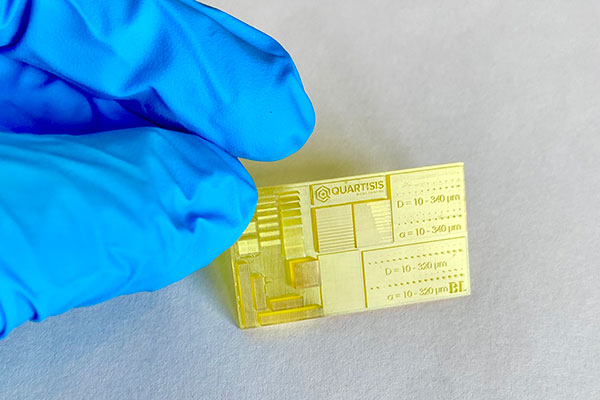
Quartisis feature plate printed on a microArch S240
Sheila: Our pursuit of becoming ISO 13485 certified is a priority for Quartisis. We’ve identified a niche market where intricate precision microstructures are paramount. The decision to acquire the BMF printer predates my arrival, but it was grounded in BMF’s standout capabilities. The printer’s ability to achieve micron-level precision, as high as two microns, sets it apart as a leader in the industry. We’re focusing on a market with exceedingly detailed precision requirements that conventional methods can’t easily fulfill.
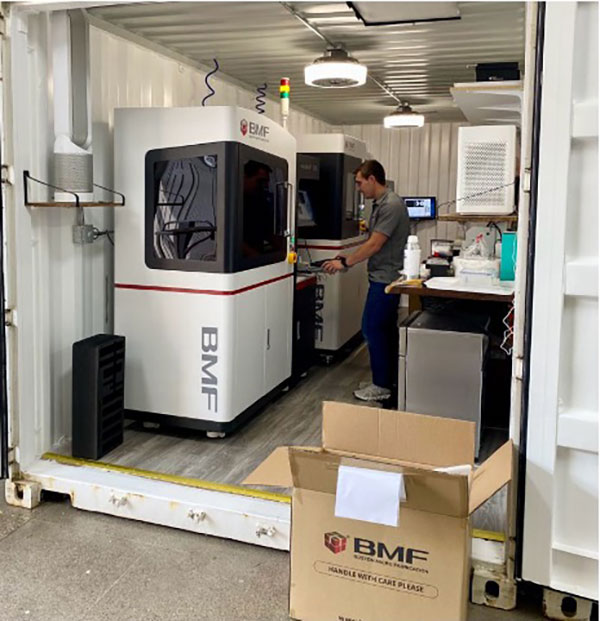
We have the privilege of housing all three of BMF’s printers: microArch S240 (10µm), the microArch S230 (2µm), and the microArch S350 (25µm) models. Our applications predominantly revolve around medical devices and electronics, with a strategic aim to expand further into the medical device domain. Integrating BMF’s printers into our stringent quality system, coupled with our journey toward ISO 13485 implementation, positions us for success in regulated industries such as the medical field.
Sheila: Everything is getting much, much smaller, whether it’s our electronics or medical devices, whether you want to make a smaller incision and you want a smaller product going into the individual. We expect demand to continue on this trajectory and precision will be the shaping force.
For certain devices, particularly those in the medical field, the need arises for incredibly small and intricate structures. The microArch S240 printer‘s micron-level capabilities come into play here. Previously, achieving such precision was challenging, especially in the realm of microstructures like lab-on-a-chip designs. The transition to 3D printing has unlocked novel possibilities for rapid, efficient, and accurate production.
Sheila: You will get unparalleled accuracy, precision and top quality. Being able to repeatedly and rapidly create multiple design iterations has been a game changer for us. You can bring in timelines for prototypes that could mean having 10 different variations or even 100 different variations. The best part is that we can test them all at once, which saves everyone so much time.
Quartisis’ trajectory showcases how embracing cutting-edge technology can revolutionize even the most specialized domains. Micro 3D printing has propelled the company beyond the confines of traditional manufacturing methodologies, enabling the fabrication of intricate microstructures with unparalleled precision. As their impact continues to extend across the realms of medical devices and electronics, Quartisis’ collaboration with BMF paves the way for a future where rapidity and accuracy coalesce seamlessly. As Sheila Ziobro and her team tenaciously push the limits of micro manufacturing, one certainty crystallizes: the path they’re forging leads to a future characterized by exquisite minuteness and profound exactness.


Boston Micro Fabrication is the world leader in micro-precision 3D printers utilizing Projection Micro Stereolithography (PµSL) technology. Many leading companies worldwide are adopting PµSL to 3D print true microstructures with ultra-high…

Ultra-high Accuracy, Precision, and Resolution Micro 3D Printed Medical Device Manufacturing
Discover how the use of micro-precision 3D printing is aiding medical device producers to tackle two common issues through this white paper.

Join over 90,000 engineering professionals who get fresh engineering news as soon as it is published.






About Us · Contact Us · Editorial Team · Advertising · Privacy Policy · Subscriber Services · © 2026 Digital Engineering 24/7 · Peerless Media