Helping design and engineering professionals discover, evaluate and specify technologies and processes that shorten the design cycle and enable success.


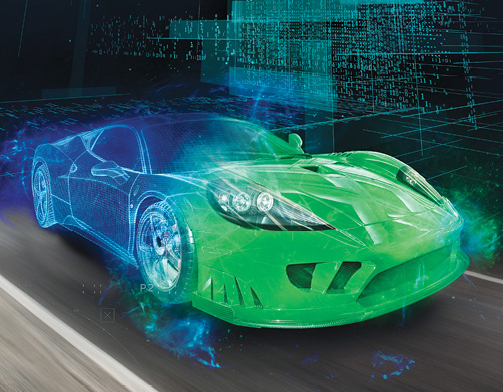

May 2026 Special Focus: Artificial Intelligence in Design and Simulation
In this Special Focus Issue, learn about the latest developments in the integration of artificial intelligence into engineering workflows.

Design & Simulation Software Guide 2025
In this Special Issue, Digital Engineering presents its second annual guide to design and simulation software vendors.
Due to their history, certain industries are better-positioned to take advantage of digital twins, observed Karen E. Wilcox, Director of the Oden Institute for Computational Engineering and Sciences, University of Texas at Austin.
"Many people point to the Apollo Program as the place where the concept was put into practice, because NASA would keep simulators on the ground to follow the progress of the spacecraft," Wilcox pointed out. This explains the reason aerospace was at the forefront of digital twin adoption and implementation, she added.
But the practice is spreading beyond aerospace. In the civil engineering, architecture, and renewable energy sectors, firms have begun employing digital counterparts of sustainable buildings, wind turbines, and bridges to keep a close eye on the physical assets. "Places where you need to know what's going on with your individual assets, but perhaps human maintenance is too costly or inconvenient -- those are the compelling situations for using digital twins," said Wilcox.
With digital twins, owners and operators often confront the Big Data problem -- how to process and extract meaningful data out of the hourly or weekly readings collected from the field devices (such as wind turbines). That's why machine learning is usually a component of digital twins, she pointed out.
"Machine learning brings powerful algorithms and ways of framing the problem so you can learn from the data," said Wilcox. "But machine learning is just one piece of the problem. You also need the predictive modeling aspect ... so the work that we're doing is an integration of powerful machine learning through the lens of physics-based models."
At the upcoming CAASE21 online conference, Wilcox will give a talk titled "Digital Twins: From Physics-Based Modeling to Scientific Machine Learning."
For more, listen to the podcast interview with Wilcox.
About this podcast
Prelude to CAASE21: The Formula for Digital Twins
June 8, 2021 at 4:00 pm
10:43 hr/min/sec
Media file
Latest podcasts
Find us
Tune in to Digital Engineering 24/7's podcast and get engineering news, products and analysis from industry experts delivered in real time. Follow us on these popular platforms:

Kenneth Wong is Digital Engineering's resident blogger and senior editor. Email him at [email protected] or share your thoughts or suggestions at digitaleng.news/facebook.
Follow DE
Join over 90,000 engineering professionals who get fresh engineering news as soon as it is published.






About Us · Contact Us · Editorial Team · Advertising · Privacy Policy · Subscriber Services · © 2026 Digital Engineering 24/7 · Peerless Media