Helping design and engineering professionals discover, evaluate and specify technologies and processes that shorten the design cycle and enable success.



Design & Simulation Software Guide 2025
In this Special Issue, Digital Engineering presents its second annual guide to design and simulation software vendors.

Design & Simulation Software Guide
In this Special Issue, Digital Engineering presents its inaugural guide to design and simulation software vendors, including listings for CAD, CAM, simulation, generative design, PLM, rendering and visualization, design for additive manufacturing,…
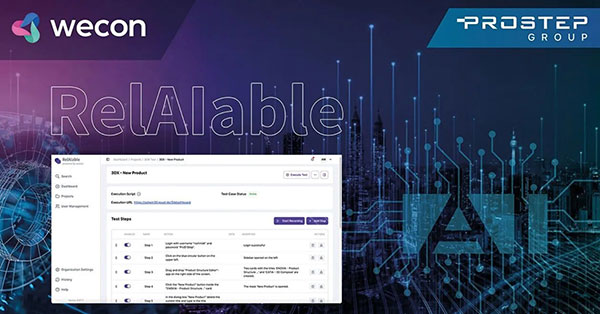
PROSTEP and Wecon PLM, an IT consulting company and service provider that specializes in software development, test and project management, will collaborate more closely on customer projects, the companies report. PROSTEP will market Wecon PLM’s RelAIable software for automating software testing and offer support when integrating the solution in their IT landscapes.
The joint offering is aimed not only at larger customers in the automotive industry, but it is also aimed at machine and plant manufacturers as well as medical equipment manufacturers.
It can be difficult to automate testing using conventional methods, which is why testing is usually performed by offshore or nearshore teams, according to PROSTEP. Wecon PLM has developed software that automates the processing of test cases with the help of artificial intelligence (AI). The software can be used to test web and desktop interfaces as well as apps for mobile devices.
RelAIable enables ability to generate scripts for testing graphical user interfaces based on natural language specifications using multimodal large language models (LLM) and to automatically adapt these scripts when changes are made. The test cases can be specified directly in RelAIable or imported from tools like Xray. The software can be integrated in test management environments such as JIRA/Xray, ALM Octane and Azure DevOps Server.
The software for automating testing was actually designed as a software-as-a-service solution, but it can also be installed on-premises.
“When testing user interfaces for big-name customers, confidential data is almost always involved. We have therefore designed the tool chain to run on site at the customer’s premises and use their AI infrastructure and/or language models. This is a key unique selling point as it protects their intellectual property and makes it easier for them to comply with data protection regulations,” syas Bernd Weber, managing director of Wecon PLM.
PROSTEP and Wecon PLM have worked together on a number of projects for BMW.
“This gave rise to the idea of stepping up this collaboration for the mutual benefit of both companies,” says Norbert Lotter, head of Near- and Offshore Operations at PROSTEP. “We are currently carrying out a proof of concept (POC) at another German carmaker with the aim of demonstrating the potential for automation and savings using real-life use cases.”
Sources: Press materials received from the company and additional information gleaned from the company’s website.


DE's editors contribute news and new product announcements to Digital Engineering. Press releases may be sent to them via [email protected].
Follow DE
Join over 90,000 engineering professionals who get fresh engineering news as soon as it is published.






About Us · Contact Us · Editorial Team · Advertising · Privacy Policy · Subscriber Services · © 2026 Digital Engineering 24/7 · Peerless Media