Helping design and engineering professionals discover, evaluate and specify technologies and processes that shorten the design cycle and enable success.


Alert!
Digital Engineering ceased publication on July 1, 2026. This website remains available as an archive of engineering content.
For inquiries or information, please email [email protected].

Digital Engineering April 2026
In the latest issue of Digital Engineering, we take a look at the latest innovations in design for additive manufacturing, including the use of natural language inputs, social media cosplayers, and AI integration. The issue also includes a feature…

January Special Focus Issue: Design for Additive
In this Special Focus Issue of Digital Engineering, learn about the latest advancements in design for additive manufacturing, including new software tools, additive in automotive, custom medical devices, and more.
In Düsseldorf, Germany, Deloitte has opened the "Smart Factory," a model factory where customers can experience Industry 4.0 live. It is intended for all industries involved in the development and production of cyberphysical systems and that have to organize collaboration between different specialist departments and integrate a large number of stakeholders inside and outside the company.
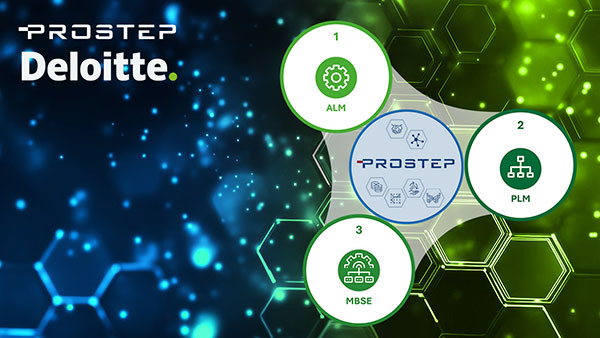
Deloitte and PROSTEP have implemented a number of practice-oriented use cases for end-to-end data processes at the factory, with a digital process chain that links requirements engineering, model-based systems engineering and development as an example. Use cases demonstrate how end-to-end traceability works and how the foundation for AI-assisted processes can be laid.
The two partners worked together on developing the end-to-end engineering process chain, bringing together Deloitte's process know-how and PROSTEP's PLM integration know-how. PROSTEP's OpenPDM solution, part of its digital thread platform, provides the basis for the integration solution. It offers standard connectors to all leading PLM, ALM and ERP systems.
"We chose PROSTEP as our partner because the company has decades of experience integrating heterogeneous system landscapes in regulated industries. Our two companies operate in a large number of different industries such as the automotive, defense, aerospace, medical technology, plant engineering and shipbuilding industries," says Tino Krüger, Partner Product Strategy & Lifecycle Management at Deloitte.
The integrated IT system landscape facilitates collaboration in system development. It also helps shorten development cycles and meet compliance requirements relating to traceability.
The use cases are based on frequently occurring development processes along the V-model. The stakeholders' requirements are initially recorded in PTC Codebeamer and transferred to Dassault Systèmes' Catia Magic Cyber Systems Engineer (formerly Cameo Systems Modeler) for the purpose of modeling the system architecture and deriving additional functional and system requirements. Once a specific level of maturity has been reached, the complete requirements package is passed on to Siemens Teamcenter for further development.
A major advantage of the implemented use cases is that the automated data interfaces make collaboration across domain boundaries easier, as Peter Pfalzgraf, partner manager at PROSTEP, explains. "The solution ensures consistent data statuses in the connected IT systems and guarantees cross-system traceability. It thus makes a contribution to speeding up the development of complex systems, which involves collaboration between multiple specialist departments."
About PROSTEP Group
PROSTEP is an independent consulting and solution development company, but also supplies ready-made product solutions. The company offers consultancy services, a range of other services, and solutions covering every aspect of product lifecycle management (PLM) and application lifecycle management (ALM).
The PROSTEP Group has more than 300 employees in Germany, Poland and the USA. In addition to its headquarters in Darmstadt, PROSTEP maintains branch offices in Berlin, Boeblingen, Hamburg, Cologne, Munich and in Wrocław (Poland), Troy, MI (USA) and its subsidiary BHC in Boeblingen.
Sources: Press materials received from the company and additional information gleaned from the company’s website.


DE's editors contribute news and new product announcements to Digital Engineering. Press releases may be sent to them via [email protected].
Follow DE






About Us · Contact Us · Editorial Team · Advertising · Privacy Policy · Subscriber Services · © 2026 Digital Engineering 24/7 · Peerless Media