Helping design and engineering professionals discover, evaluate and specify technologies and processes that shorten the design cycle and enable success.



Digital Engineering April 2026
In the latest issue of Digital Engineering, we take a look at the latest innovations in design for additive manufacturing, including the use of natural language inputs, social media cosplayers, and AI integration. The issue also includes a feature…

January Special Focus Issue: Design for Additive
In this Special Focus Issue of Digital Engineering, learn about the latest advancements in design for additive manufacturing, including new software tools, additive in automotive, custom medical devices, and more.
Protolabs expanded its 3D printing capabilities by launching an advanced photopolymers technology. Axtra3D Hybrid PhotoSynthesis (HPS) offers repeatable and detailed 3D printed parts at higher speeds, the company reports. HPS uses a precision laser and digital light processing (DLP) system to image internal and external part structures—a dual 3D printing approach.
HPS complements Protolabs’ current Carbon digital light synthesis (DLS) printers for 3D printing projects that require stronger mechanical properties. Carbon DLS and HPS feature near-isotropic parts and smooth surface finishes, but HPS technology also offers high resolution when compared to other 3D printing processes, Protolabs reports.
Common HPS applications include production-grade parts with excellent throughput, parts requiring high-accuracy features for testing and validation, and cosmetic prototypes requiring glass-like surface finishes.
“We are committed to establishing additive manufacturing as a technology that can take companies from prototyping to production,” said Ryan Kees, Protolabs 3D printing global product director. “To help product developers, designers, and engineers do that, Hybrid PhotoSynthesis is another vital production option in our growing toolbox of 3D printing capabilities.”
Currently available HPS materials include Tough Black (Loctite Henkel 3843), an engineering-grade resin with high strength, impact resistance, and surface finish, and ceramic-filled (BASF 3280), a material often used for tooling and molding due to its high stiffness. Both materials expand Protolabs’ advanced photopolymer library, adding to the materials already offered for Carbon DLS.
Sources: Press materials received from the company and additional information gleaned from the company’s website.


Proto Labs is the world's fastest source for custom prototype and low-volume parts. Our 3D printing, CNC machining and injection molding services utilize proprietary computing technology and automated systems to produce quality parts in a…
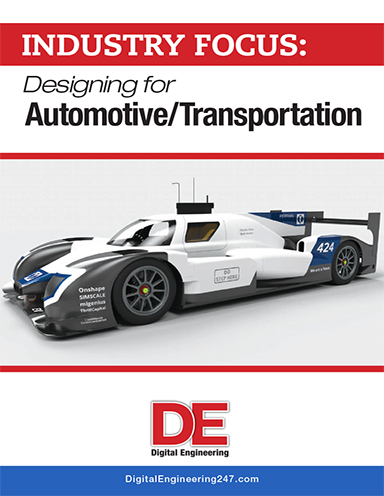
Designing for Automotive/Transportation
The automotive industry is past the point of talking about the disruption coming from demand for electric vehicle powertrains or the potential of autonomous vehicles, and well on its way to responding to those disruptions thanks to advanced engineering technologies. Download this special digital edition.

DE's editors contribute news and new product announcements to Digital Engineering. Press releases may be sent to them via [email protected].
Follow DE
Join over 90,000 engineering professionals who get fresh engineering news as soon as it is published.






About Us · Contact Us · Editorial Team · Advertising · Privacy Policy · Subscriber Services · © 2026 Digital Engineering 24/7 · Peerless Media