Helping design and engineering professionals discover, evaluate and specify technologies and processes that shorten the design cycle and enable success.



Digital Engineering April 2026
In the latest issue of Digital Engineering, we take a look at the latest innovations in design for additive manufacturing, including the use of natural language inputs, social media cosplayers, and AI integration. The issue also includes a feature…

January Special Focus Issue: Design for Additive
In this Special Focus Issue of Digital Engineering, learn about the latest advancements in design for additive manufacturing, including new software tools, additive in automotive, custom medical devices, and more.
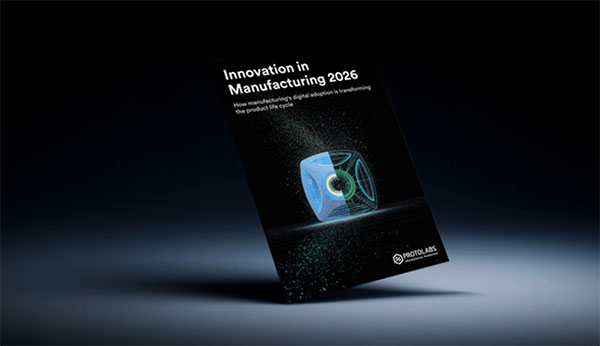
Protolabs has launched the Innovations in Manufacturing report. The report shows there’s now a definitive shift from experimentation to aggressive scaling. Manufacturers applying machine learning are three times more likely to improve key performance indicators compared to those that do not, according to Protolabs.
In 2026, this transformation spans the product life cycle, with technology-driven innovations redefining how products are conceived, developed, produced, and eventually retired. The biggest changes are driven by a small set of technologies that are converging into integrated workflows. Those workflows are compressing development time, reducing risk, enabling new geometries and materials, and pushing manufacturing toward smarter, more autonomous systems.
72%: manufacturers that build machine learning into their processes report reduced costs & improved operational efficiency
20%-50%: development time can be saved by implementing digital twin technology, resulting in improved product performance and lower costs
58%: of companies are piloting co-creation initiatives, as collaborating with customers becomes more common
50%: reduction in development costs and 30% faster time to market can be attributed to AI-enabled digital threads
97% of companies report delays or failure with bringing products to market, as scaling to production remains the biggest challenge for product developers
72%: of manufacturing leaders report using on-demand manufacturing for improved flexibility
Manufacturing is entering an increasingly digitalized era, driven by a suite of new technologies that result in a more intelligent, connected, and adaptive approach to manufacturing. Note that the trend in manufacturing is not these technologies in isolation, but industry of things (IoT), for example, fused with artificial intelligence (AI) and twin environments to create self-optimizing operations.
The new technologies in the report include: digital twins; generative AI (today) and quantum computing; digital product passports and circular economy models; rapid prototyping and additive manufacturing; autonomous production systems; AI; agile, modular, and data-driven approaches; and end-of-life processes.
The first stage of the product life cycle is where design decisions are made, and this is where manufacturing is undergoing the most significant changes. Traditional prototyping cycles are increasingly being replaced by simulation-first product development thanks to the introduction of several new technologies that integrate AI and large language models (LLMs).
GenAI, for example, is demonstrating great potential to optimize ideation. A total of 47% of product development teams plan to use generative AI at scale, and 88% of organizations report applying AI in at least one business function.
Engineers are increasingly adapting a design for manufacturability (DFM) discipline, based on digital twins and production simulators.
Looking to the future, quantum-enhanced concept development is emerging as a catalyst for ideation, especially in the simulation of materials and complex systems. While in its early stages in manufacturing applications, its trajectory is significant. The ability to model quantum mechanical phenomena while simultaneously managing classical engineering constraints will open new horizons in product design.
For more report details, click here. Download the report here.
Sources: Press materials received from the company and additional information gleaned from the company’s website.


Proto Labs is the world's fastest source for custom prototype and low-volume parts. Our 3D printing, CNC machining and injection molding services utilize proprietary computing technology and automated systems to produce quality parts in a…
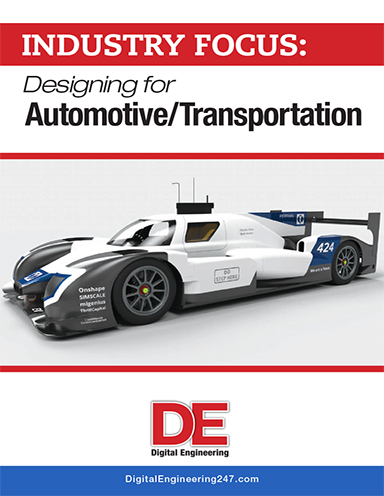
Designing for Automotive/Transportation
The automotive industry is past the point of talking about the disruption coming from demand for electric vehicle powertrains or the potential of autonomous vehicles, and well on its way to responding to those disruptions thanks to advanced engineering technologies. Download this special digital edition.

DE's editors contribute news and new product announcements to Digital Engineering. Press releases may be sent to them via [email protected].
Follow DE
Join over 90,000 engineering professionals who get fresh engineering news as soon as it is published.






About Us · Contact Us · Editorial Team · Advertising · Privacy Policy · Subscriber Services · © 2026 Digital Engineering 24/7 · Peerless Media