Helping design and engineering professionals discover, evaluate and specify technologies and processes that shorten the design cycle and enable success.


Alert!
Digital Engineering ceased publication on July 1, 2026. This website remains available as an archive of engineering content.
For inquiries or information, please email [email protected].

May 2026 Special Focus: Artificial Intelligence in Design and Simulation
In this Special Focus Issue, learn about the latest developments in the integration of artificial intelligence into engineering workflows.

Design & Simulation Software Guide 2025
In this Special Issue, Digital Engineering presents its second annual guide to design and simulation software vendors.
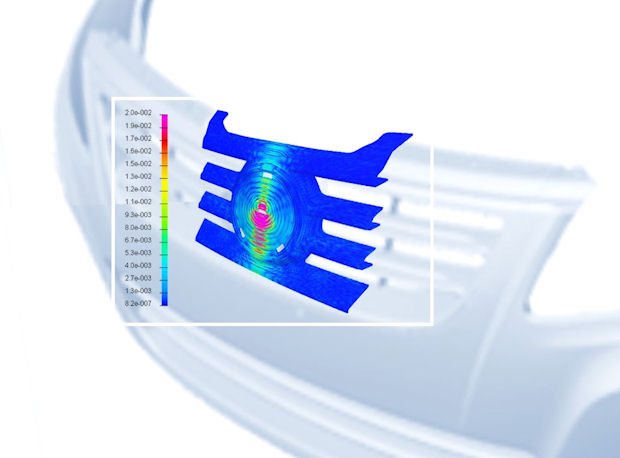 Many of the enhancements in CEM Solutions 2014 focus on automotive applications. This image shows a radar sensor radiating across an automobile’s front plastic grill (induced currents at 77 GHz). Image courtesy of the ESI Group.
ESI describes CEM Solutions as a consolidated software system comprising two of its computational electromagnetics (CEM) applications, PAM-CEM Simulation Suite and Efield Solutions. PAM-CEM Simulation Suite operates mainly within the medium- to high-frequency range. Efield Solutions is frequency-domain oriented with a focus on antennas and scattering. The CEM Solutions suite offers components for such applications as EMC/EMI (electromagnetic compatibility/electromagnetic interference) with cable networks, antenna placement and radar signatures.
CEM Solutions, according to the company, integrates all major computational electromagnetics time and frequency methods within a single framework through Visual-CEM, which is a portion of ESI Group’s multidomain simulation platform. This, explains the company, provides efficient simulation of electromagnetic phenomena using coupled and hybrid techniques, which, in turn, enables fully realistic virtual prototypes.
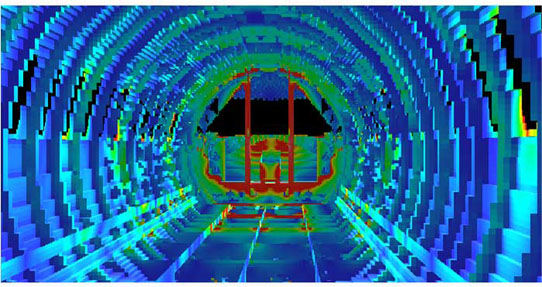 An Efield simulation of a lightning strike on a SAAB 2000 jet showing the surface currents inside the aircraft. Image courtesy of the ESI Group.
Updates in CEM Solutions 2014 for the automotive sector include enhanced virtual testing capabilities with a dedicated radio noise process. The company explains that this capability allows engineers to evaluate spurious electromagnetic noise from internal cabling and other emitting components to determine their effects on onboard antennas, receivers and similar devices.
Additional enhancements for engineers in the automotive sector include a multi-scale modeling process that combines standard computational techniques with analytical formations as well as the ability to investigate the performance of 24GHz radar sensors located behind plastic bumpers. CEM Solutions 2014 has also been updated to take into account precise design parameters such as 3D shapes and surface coating, enabling the evaluation of phenomena induced by very thin metallic paint coatings. The company adds that CEM Solutions 2014 can address millimeter-wave (77 GHz) radar sensors used in active safety applications, long-range detection and advanced driver assistance.
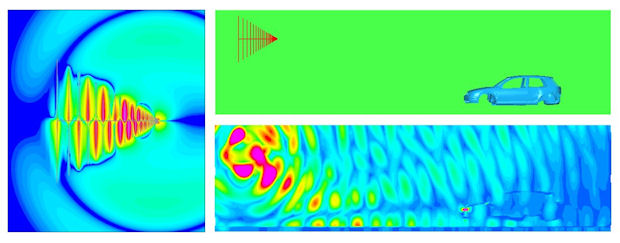 This screen shot shows a virtual anechoic chamber. The PAM-CEM/FD 3D explicit finite difference time domain solver of CEM Solutions 2014 was used for this analysis. Image courtesy of the ESI Group.
CEM Solutions 2014 also offers expanded functionality for engineers working on aeronautics, defense and marine applications. Among these are enhancements for radar absorbing materials used for stealth purposes, multilayer radome structures and other phased array antennas.
The Visual-CEM virtual environment provided with CEM Solutions 2014 has been upgraded to version 9.5. Visual-CEM is actually a part of the company’s Visual-Environment integrated environment for multidomain engineering simulation. Visual-CEM provides you the support for computational engines operating in both time and frequency domains. Additionally, it offers updated 3D polar plots, which are a must for antenna design and scattering studies, according to the ESI Group.
For further details on CEM Solutions 2014, go here.
Download the “CEM Solutions in Automotive” brochure.
Download the PAM-CEM Simulation Suite brochure.
Read a technical paper: “Antenna for Wireless Intra-Vehicle Communication at ISM 61 GHz Band.”
Learn more about the ESI Visual-Environment.
See why DE's editors selected CEM Solutions 2014 as their Pick of the Week.
Sources: Press materials received from the company and additional information gleaned from the company's website.


Anthony J. Lockwood is Digital Engineering's founding editor. He is now retired. Contact him via [email protected].
Follow DE






About Us · Contact Us · Editorial Team · Advertising · Privacy Policy · Subscriber Services · © 2026 Digital Engineering 24/7 · Peerless Media