Helping design and engineering professionals discover, evaluate and specify technologies and processes that shorten the design cycle and enable success.



Digital Engineering April 2026
In the latest issue of Digital Engineering, we take a look at the latest innovations in design for additive manufacturing, including the use of natural language inputs, social media cosplayers, and AI integration. The issue also includes a feature…

January Special Focus Issue: Design for Additive
In this Special Focus Issue of Digital Engineering, learn about the latest advancements in design for additive manufacturing, including new software tools, additive in automotive, custom medical devices, and more.
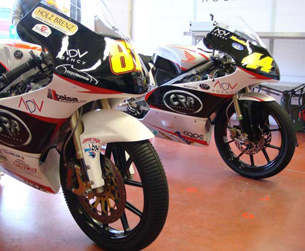 Single front disk and dual front disk |
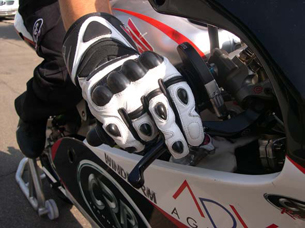 Short standard arm: hand position in using brakes |
While thebrake lever was being examined, the team replaced Moretti’s singlelarge-diameter brake disk with two of smaller diameter. This solution improvedthe bike’s stability while braking and eliminated some twisting observed in thefront fork. Once the dual disks were in place, Moretti asked for more aggressivebraking.
Typically, a series of long standard brake levers are used toincrease a rider’s braking force, but getting the length and position just righthas to take into account the uniqueness of each individual rider. For example,Moretti’s fingers are shorter than the average brake lever allows for, so theresting position for the long brake lever had be set closer to the rider’s handon the throttle grip. In this case, the resulting position ended up so close tothe hand that Moretti’s two outside fingers were crushed whenever he applied thebrakes. It’s no surprise, then that Moretti reported that he would be fullyfocused on trying to maintain control and avoid crashing—not on winning arace.
Reverse Engineering to the Rescue
CRP team members used aPlatinum Faro Arm, an optical scanning system with 7 axes equipped with anoptical Faro Laser Line Probe to scan Moretti’s right hand while in its familiarriding position on his bike. Fully portable, the system makes it possible foroperators to scan 3D objects to acquire measurements in challenging positions.The optical scanner acquired images of Moretti’s hand in different postures andwhile applying the brakes, then translated the information into a CADenvironment.
With additional scanning, a CAD model of a long standardbrake lever was developed as was one of a standard short lever. This allowed theteam to set up the brake lever according to the rider’s requirements. Bycomparing the two and taking Moretti’s hand position and finger length intoconsideration, a design for a customized long lever was developed that combinedthe comfortable rider position using the short lever and the superior brakingforce enabled by the long lever. The result was a lever longer from the indexfinger position to the pivot. Using this setup, the team also determined thatwith the new long lever Moretti would be able to increase braking pressurewithout increasing the force he had to put on the lever by moving the levermount (brake cylinder) toward the center of the handlebar by only a fewmillimeters.
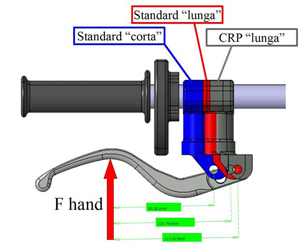 Position of the brake pump for short standard brake arm (blue), long standard arm (red), and CRP long arm |
The geometry that resulted from this work resembled theshort standard brake lever where it was grasped by the fingers, but the longstandard lever in the section that ran from the fingers to the mounting pivot.By analyzing the functionality and 3D models of the short and long standardbrake levers, in tests on the track, situations that formerly resulted incrushed fingers and accidental contact with the throttle control could beavoided.
The result was called the “CRP long” ergonomic brake lever. Thenew CRP long lever puts increased force on the brake cylinder. The distance fromfinger position to fulcrum of the three models are as follows:
−Short arm brake = 95.3 mm
− Long arm brake = 110.7 mm
− CRP longarm brake = 117.4 mm
It should be clear that Moretti gets more leveragewith the final design. Validation showed that using the standard long leverresulted in an increased force (Fpump) of only 16 percent over the short leveras compared to 23 percent when using the CRP long lever. CRP Technology testedthe geometry for possible interferences using an SLS prototype created in itsown Windform GF, a composite polyamide based material.
The designunderwent more CAD correction and geometry validation, even after the latestversion of the brake lever was mounted on the motorcycle. The shape of Moretti’shand while using the CRP long brake lever was submitted to a second survey toensure accuracy.
The final brake lever was cut of Ergal 7075 commercialaluminum that was machined with wire EDM, drilled, finished by hand, and finallyanodized in black. RP Technology reported that it took a total of 48 hours to gofrom the optical scanning and CAD modeling of standard arms to produce the CRPbrake lever.
Since May, 2008, Moretti has been using the CRP long brakelever in racing championships and has declared it his favorite.
More Info
CRP Technology
Modena, Italy
FARO Technologies, Inc.
Lake Mary, FLA
Susan Smith is a contributing editor for Desktop Engineering magazine. She has been an editor and writer for the technology industry for more than 15 years and resides in Santa Fe, NM. Send e-mail about this article to [email protected].


DE's editors contribute news and new product announcements to Digital Engineering. Press releases may be sent to them via [email protected].
Follow DE
Join over 90,000 engineering professionals who get fresh engineering news as soon as it is published.






About Us · Contact Us · Editorial Team · Advertising · Privacy Policy · Subscriber Services · © 2026 Digital Engineering 24/7 · Peerless Media