Helping design and engineering professionals discover, evaluate and specify technologies and processes that shorten the design cycle and enable success.




Design & Simulation Software Guide 2025
In this Special Issue, Digital Engineering presents its second annual guide to design and simulation software vendors.

Design & Simulation Software Guide
In this Special Issue, Digital Engineering presents its inaugural guide to design and simulation software vendors, including listings for CAD, CAM, simulation, generative design, PLM, rendering and visualization, design for additive manufacturing,…
Officially introduced earlier this year, Seebo bills itself as an end-to-end platform that makes it easier to design and prototype IoT devices, initially targeting consumer products, but more recently expanding into the industrial sector. Buttressed by 18 patents, the Seebo platform lets designers spec out the IoT features of their product using drag-and-drop functionality, reducing the number of IoT experts needed on the development staff.
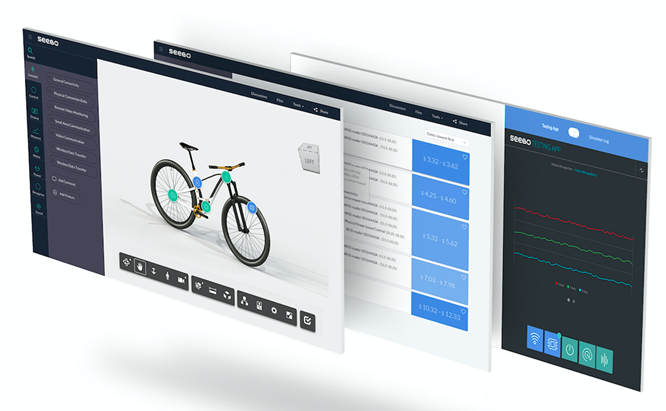 Seebo’s virtual simulation provides instant feedback on product concepts. Image Courtesy of Seebo
“Most IoT platforms collect data or analyze data or create logic to deal with data, but Seebo choose a difference focus,” explains Lior Akavia, CEO of the Israel-based company. “We focusing on the development process, making it easier to plan, develop and integrate IoT products.”
With Seebo IoT Creator, manufacturers explore smart features in a virtualized environment, which allows them to evaluate a variety of hardware components and costs, employing the platform’s proprietary algorithms to pick the optimal hardware combination based on the concept and specifications, Akavia explains. Once selected, IoT Creator automatically configures the SDKs, Simulator, IoT development Kit and testing applications, providing a significant head start in what is typically a long and laborious planning and development process, he explains. The platform also has a real-time electronics BOM (Bill of Materials) optimizer, which provides instant pricing updates every time a new component is added.
In its latest incarnation, Seebo has added a “Simulator” to its IoT Creator platform, which is a virtualized hardware environment that eliminates the need to code against actual hardware — another way of accelerating time to market and reducing costs. “It delivers a visual simulation of the new IoT product — how the sensors or communication modules are going to work,” Akavia explains. Developers simply use the planning tool to define the IoT features of the product, grab the proper elements using drop-and-drop capabilities, and with a click of a button, they can simulate the proposed product concept, exploring different permutations, which the platform also ranks based on requirements.
“We have a catalog of hundreds of different features, which users can customize or create new features for IoT products,” he explains.
In addition to the core platform, Seebo offers consulting services, working with customers on such IoT-related development tasks as software and firmware development while also providing tools for testing prototypes' actions, Akavia says. Beyond development of the core product platform, Seebo will connect customers with its network of mobile app developers and provide access to its component sourcing database, that lets shops compare between suppliers.
 Mookie Toys leveraged Seebo IoT Creator to fast track its Story Stars line of IoT-enabled creatures. Image Courtesy of Mookie Toys
Mookie Toys found the Seebo platform instrumental in the design of its line of IoT toys, according to Guy Orr, director for the firm. Seebo IoT Creator helped acquaint the firm with IoT technologies like sensors and chips, and the firm was instrumental in helping Mookie get optimal pricing on components, he explains.
“It was peace of mind,” Orr says. “If we were to do all of it ourselves, it would have been a much longer development process and the route to market would have been twice as long.”


Beth Stackpole is a contributing editor to Digital Engineering. Send e-mail about this article to [email protected].
Follow DE
Join over 90,000 engineering professionals who get fresh engineering news as soon as it is published.






About Us · Contact Us · Editorial Team · Advertising · Privacy Policy · Subscriber Services · © 2026 Digital Engineering 24/7 · Peerless Media