Helping design and engineering professionals discover, evaluate and specify technologies and processes that shorten the design cycle and enable success.



May 2026 Special Focus: Artificial Intelligence in Design and Simulation
In this Special Focus Issue, learn about the latest developments in the integration of artificial intelligence into engineering workflows.

April 2026 Special Focus Issue: Generative Design
In this Special Focus Issue, Digital Engineering takes a look at how generative design solutions can be used across different types of design problems and with a variety of manufacturing approaches to accelerate design space exploration, and…
Clearly, the mouse-and-keyboard combo was never meant to be an input system for working with 3D data. It was designed for text input (dating back to the DOS command-line era), but it was adopted by CAD users, for the lack of alternatives. Over time, familiarity gave CAD users the impression that rotating 3D models with a mouse cursor was the standard mode of operation.
But we now have better alternatives, spawned by companies that dare to challenge the status quo in 3D input. Many CAD users are familiar with 3D Connexion, a 3D mice supplier. With a rotating ball that mimics the movements of a 3D object, 3D mice give users a more intuitive way to control and manipulate 3D models in CAD programs.
At Siemens PLM Connection Conference, Germany-headquartered SpaceControl took up a booth to elbow its way into the U.S. market. Its line of 3D mice is quite similar to those sold by 3D Connexion, now considered a veteran in 3D input market. Let's see if I can help you distinguish the two. 3D Connexion happens to have a space-themed product line: SpacePilot, SpaceMouse, SpaceExplorer, and SpaceNavigator. The German company's name is SpaceControl, whose product is called SpaceController.
Aside from the 3D mice, the emergence touch-enabled tablets are also redefining how people interact with 3D data. The growing list of CAD viewing mobile apps now available for the iPad and other touch-sensitive tablets, for example, is forcing hardware providers to rethink CAD display. Rotating a model on a multi-touch display is much more intuitive than doing the same with a mouse. Hardware makers like HP are beginning to peddle large displays with multi-touch technologies to CAD users. If multi-touch displays become widespread, viewing and annotating detailed drawings would no longer be the same.
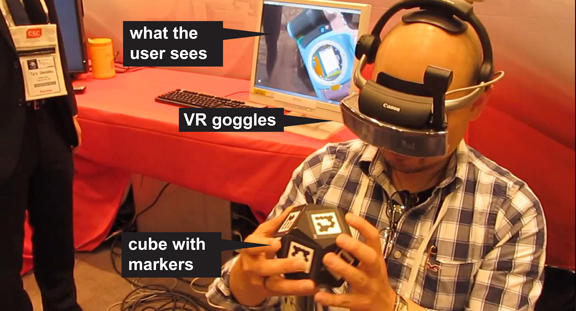
The real cutting edge, as seen by the experimental technologies from Canon on display at the show, is augmented reality. You may know Canon as the famous camera maker, but the company is also delving into what some might call the sci-fi realm. With the use of virtual-reality (VR) goggles that can interpret computer-recognizable markers as 3D data, you can be literally holding 3D data that doesn't exist in the real world (it must exist at least as a CAD model, of course).
For a video report on the hardware found at Siemens PLM Connection 2012, watch the video clip below (video taken with a Canon PowerShot SX150 IS; footage of Canon demonstration shot by Ken Ohashi, analyst, ISG Strategic Planning Division, Canon U.S.A.):


Kenneth Wong is Digital Engineering's resident blogger and senior editor. Email him at [email protected] or share your thoughts or suggestions at digitaleng.news/facebook.
Follow DE
Join over 90,000 engineering professionals who get fresh engineering news as soon as it is published.






About Us · Contact Us · Editorial Team · Advertising · Privacy Policy · Subscriber Services · © 2026 Digital Engineering 24/7 · Peerless Media