Helping design and engineering professionals discover, evaluate and specify technologies and processes that shorten the design cycle and enable success.


Alert!
Digital Engineering ceased publication on July 1, 2026. This website remains available as an archive of engineering content.
For inquiries or information, please email [email protected].

Digital Engineering April 2026
In the latest issue of Digital Engineering, we take a look at the latest innovations in design for additive manufacturing, including the use of natural language inputs, social media cosplayers, and AI integration. The issue also includes a feature…

January Special Focus Issue: Design for Additive
In this Special Focus Issue of Digital Engineering, learn about the latest advancements in design for additive manufacturing, including new software tools, additive in automotive, custom medical devices, and more.
Even if you didn’t grow up watching the Jetsons zoom to school, work, and shopping in personal flying machines, you can understand the appeal. Who wouldn’t want to rise above traffic jams: soar over highways, bypass stoplights, and arrive at anywhere in a tenth of ordinary earthbound commute-time?
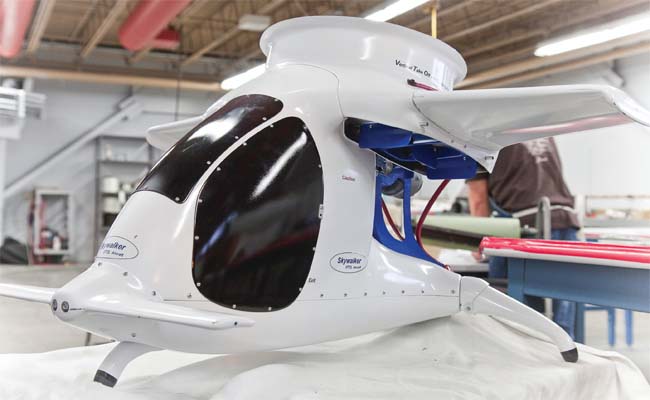 The 2005 Skywalker vertical take-off and landing aircraft quarter scale model stands about 24 in. high. All parts are made from advanced composite graphite materials. |
Designers at Mirror Image Aerospace of Ogden, Utah, have spent more than a decade working on just such a concept called the Skywalker Vertical Take-Off and Landing (VTOL) personal air vehicle. Thanks to improvements in rapid technologies, solid modeling, and computational fluid analysis, the design has continued to evolve, but the basic concept relies on a pair of fixed, counter-rotating turbine-style propellers within a shrouded-intake air duct.
Mirror Image Aerospace’s first Skywalker prototype in 2000 relied upon conventional materials and assembly procedures. The design changed and in 2007 the use of rapid parts fabrication became the key to creating an affordable, quarter-scale model. Company CEO Kent Crookston, a composites expert and 30-year aviation-business veteran, has used a Z Corporation 310 3D printer for five years. He was familiar with its powder-matrix operation and knew it could generate parts with the necessary level of detail.
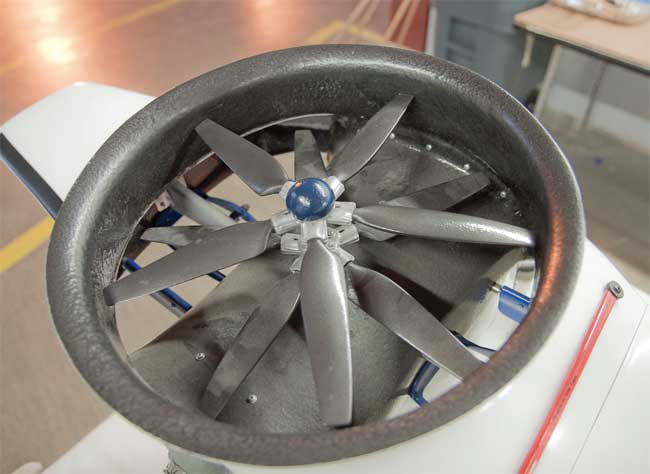 Top view of the counter rotating blades. There are two, five-bladed hub assemblies and a cone-shaped spinner cap. |
The team built a quarter-scale model of the complete engine, counter-rotating blades, hubs, spinner (cap) on the hubs and transmission mount using Z Corp’s gypsum material. The parts cost considerably less than they would have if manufactured using stereolithography, and were easily painted or reinforced with fiberglass epoxy.
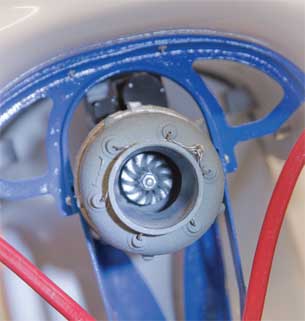 This is a quarter-scale model of a Solar T-32 turbine engine. Air duct supports are painted blue. The turbine engine and air duct structures were manufactured on the Z Corp 310 3D printer. |
For larger parts such as the actual body, wings and landing gears, Crookston spent months building mold patterns manually. For many of the other parts, he feels he could not have accurately produced them without 3D printing. He says, “The counter-rotating blades had to be opposite, mirror images, which would be very difficult to make by hand.”
Mirror Aerospace is now on a fast track to get in the air. This past year’s efforts have resulted in a top-to-bottom redesign based on CFD analysis results, and for weight-savings the Skywalker will use composite materials as much as possible. The new vehicle features a wider fuselage, two-passenger capacity, and improved aerodynamics. Construction of the working prototype begins in February 2010. So far the project has been self-funded, but Mirror Aerospace is happy to talk with interested parties.
Skywalkers are designed to be kit-built, and for now, require a pilot’s license, but thanks to 3D printing, the day of Jetson-craft for all of us is coming closer.
More Info:
Mirror Image Aerospace
Contributing Editor Pamela J. Waterman, DE’s simulation expert, is an electrical engineer and freelance technical writer based in Arizona. You can send her e-mail to [email protected].


Pamela Waterman worked as Digital Engineering's contributing editor for two decades. Contact her via DE-Editors@ digitaleng.news.
Follow DE






About Us · Contact Us · Editorial Team · Advertising · Privacy Policy · Subscriber Services · © 2026 Digital Engineering 24/7 · Peerless Media