Helping design and engineering professionals discover, evaluate and specify technologies and processes that shorten the design cycle and enable success.



May 2026 Special Focus: Artificial Intelligence in Design and Simulation
In this Special Focus Issue, learn about the latest developments in the integration of artificial intelligence into engineering workflows.

April 2026 Special Focus Issue: Generative Design
In this Special Focus Issue, Digital Engineering takes a look at how generative design solutions can be used across different types of design problems and with a variety of manufacturing approaches to accelerate design space exploration, and…
Last September, when U.S. district judge Richard A. Jones rendered his judgment in Vernor vs. Autodesk, he sided with ebay merchant Vernor, declaring "Mr. Vernor has prevailed in his claim that Autodesk’s copyright does not prevent him from reselling his AutoCAD packages." ("Software Resale on eBay: Court Sided with Reseller," October 13, 2009).
Near the end of his 26-page statement, Jones also cautioned, "[Courts] across the nation have issued rulings that adopt and reject the equivalent of the parties’ positions here. Vernor, 555 F. Supp. 2d at 1174 (citing rulings from courts in California, New York, and Utah). Since that opinion, at least two more courts have joined the cacophony. The MDY court [which decided the MDY Industries vs. Blizzard Entertainment case] favored the copyright holder, whereas the court in UMG Recordings [UMG Recordings Inc. vs. Augusto] favored the consumer."
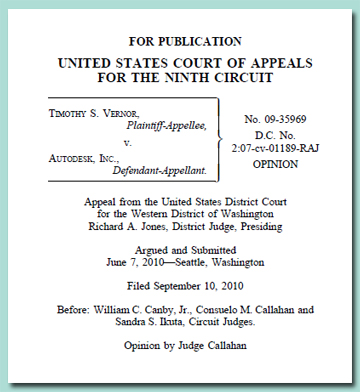
This week, Jones' observations prove prophetic. The 9th Circuit U.S. Court of Appeals reversed his ruling. "Autodesk retained title to the software and imposed significant transfer restrictions," 9th Circuit Judge Consuelo Callahan wrote for a unanimous three-judge panel. "It stated that the license is nontransferable, the software could not be transferred or leased without Autodesk's written consent ..." ("Autodesk Wins Copyright Appeal," Reuters, Sep 10, 2010).
Most software merchants like Autodesk contend that their software is "licensed," not "sold"; therefore, they argue, software buyers (or licensees) cannot resell, trade, or transfer their software (like they could with, say, used books or furniture). Vernor brought the case against Autodesk, hoping to be able to sell the used copies of AutoCAD in his possession without interference from Autodesk.
To make his case, Vernor cited The First Sale Doctrine, which allows a buyer to transfer, sell, or give away a lawfully made copy of a copyrighted item. Rendering his opinion, Judge Callahan wrote, "We hold that because CTA [the business from which Vernor bought the used copies of AutoCAD] is a licensee, not an owner, the 'sale' of its [AutoCAD] Release 14 copies to Vernor did not convey ownership. Vernor is accordingly not entitled to invoke the first sale doctrine ..."
If you disagree with this ruling, Callahan has a suggestion: "Congress is free, of course, to modify the first sale doctrine and the essential step defense if it deems these or other policy considerations to require a different approach."
So the legal drama known as Vernor vs. Autodesk continues.
To read Judge Callahan's opinion, click here.


Kenneth Wong is Digital Engineering's resident blogger and senior editor. Email him at [email protected] or share your thoughts or suggestions at digitaleng.news/facebook.
Follow DE
Join over 90,000 engineering professionals who get fresh engineering news as soon as it is published.






About Us · Contact Us · Editorial Team · Advertising · Privacy Policy · Subscriber Services · © 2026 Digital Engineering 24/7 · Peerless Media