Helping design and engineering professionals discover, evaluate and specify technologies and processes that shorten the design cycle and enable success.



May 2026 Special Focus: Artificial Intelligence in Design and Simulation
In this Special Focus Issue, learn about the latest developments in the integration of artificial intelligence into engineering workflows.

April 2026 Special Focus Issue: Generative Design
In this Special Focus Issue, Digital Engineering takes a look at how generative design solutions can be used across different types of design problems and with a variety of manufacturing approaches to accelerate design space exploration, and…
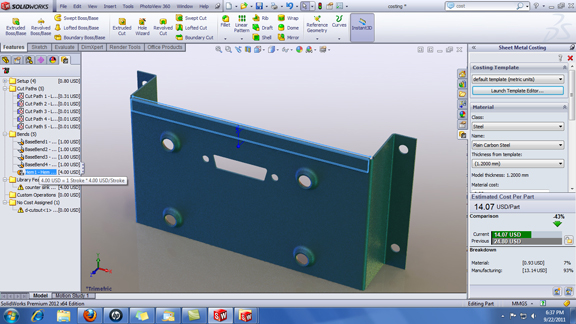
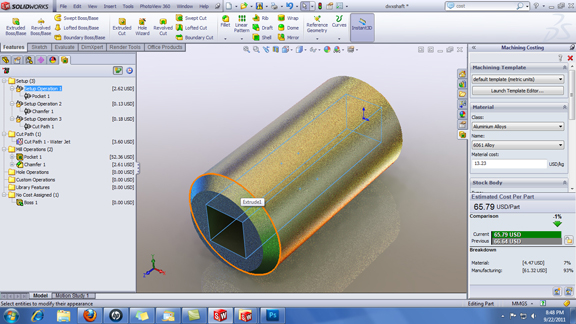
SolidWorks 2012, now in pre-release code, is about to show you the bottom line -- quite literally. The new version comes with SolidWorks Costing, a module you can use to estimate how much it'll cost to produce a sheet-metal part or a machined part. The software calculates manufacturing costs using a set of preloaded templates with prices for standard sheet-metal and machining operations. (No template for injection-molded plastic parts in this release, but perhaps one is in development.) To get more accurate results, most manufacturers will probably modify the templates by populating relevant fields with their own materials, unit costs, and supplier quotes.
The module, found under Tools tab, is fairly straightforward. The moment you launch it, it begins calculating. The software can tell the difference between a sheet-metal part from a machined part, so you'll only get the one that's relevant to the part found in your modeling window. Calculations are done based on standard sheet-metal punching or machining operations required to produce the features found in your geometry (for instance, the number of pockets, holes, and bends). The results are updated in real-time. (OK, near real-time, if you want to nitpick, because it does take a few seconds for the software to crunch numbers.)
Perhaps this is exactly the type of calculation you're used to doing with pen and paper; perhaps you already have an Excel spreadsheet with embedded formulas that can spit out the same estimates based on manual input. Either way, you'll find that the ability to automate this grueling process comes with great benefits. You may, for instance, change the thickness of a sheet-metal part or switch from steel to iron to find out how it affects the bottom line. You may also experiment with removing or adding features to see if you can reduce the cost. Tight integration with a 3D model makes it easy to explore different alternatives.
Currently, the module can be used only to estimate costs on parts, but assembly support with the option to get a roll-up cost is already in the work, based on what SolidWorks has previewed to reporters. In structure and setup, SolidWorks Costing is uncannily similar to SolidWorks Sustainability Xpress, now shipping with every copy of the software as a standard component.
The three pillars of modern manufacturing -- cost, durability (achievable via analysis and simulation), and sustainability -- now coexist in SolidWorks, just a few tabs away from one another. When the three come together, perhaps in a consolidated display tab, SolidWorks will significantly change the mechanical design culture once more.
For a demonstration of SolidWorks Costing, watch the video clip below:


Kenneth Wong is Digital Engineering's resident blogger and senior editor. Email him at [email protected] or share your thoughts or suggestions at digitaleng.news/facebook.
Follow DE
Join over 90,000 engineering professionals who get fresh engineering news as soon as it is published.






About Us · Contact Us · Editorial Team · Advertising · Privacy Policy · Subscriber Services · © 2026 Digital Engineering 24/7 · Peerless Media