Helping design and engineering professionals discover, evaluate and specify technologies and processes that shorten the design cycle and enable success.



Digital Engineering April 2026
In the latest issue of Digital Engineering, we take a look at the latest innovations in design for additive manufacturing, including the use of natural language inputs, social media cosplayers, and AI integration. The issue also includes a feature…

January Special Focus Issue: Design for Additive
In this Special Focus Issue of Digital Engineering, learn about the latest advancements in design for additive manufacturing, including new software tools, additive in automotive, custom medical devices, and more.
In conjunction with the launch of the space shuttle Endeavor, Microsoft Live Labs launched a preview version of its Photosynth photo-imaging technology. Photosynth uses hundreds of digital camera images to construct a 3D environment that can be navigated and explored. The online preview features Endeavour on the launch pad and the interior and surrounding area of the Vehicle Assembly Building, which houses external fuel tanks and flight hardware.
Before docking at the International Space Station, Endeavour did a backflip so that astronauts on the space station could photograph the shuttle’s bottom to detect any tile damage. Some of the nearly 300 images are now viewable through Photosynth. Users can zoom out to view a point-cloud representation of the shuttle, or zoom in to specific areas to view individual photos.
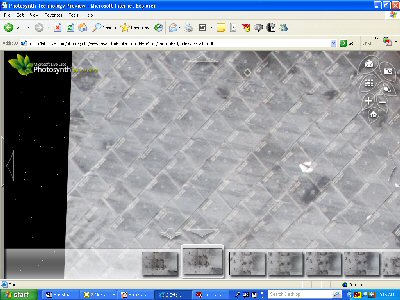 |
| Microsoft's Photosynth displays tiles on a portion of the Space Shuttle Endeavour. |
Each photo is processed by computer vision algorithms to create a point-cloud image and describe hundreds of distinctive features within the image. Photos that share features are then linked together in a web. When the same feature is found in multiple images, its 3D position can be calculated.
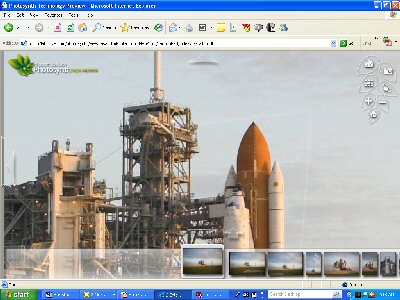 |
| Photosynth lets users navigate around Endeavour and zoom in for greater detail as it sits on the launch pad. |


DE's editors contribute news and new product announcements to Digital Engineering. Press releases may be sent to them via [email protected].
Follow DE
Join over 90,000 engineering professionals who get fresh engineering news as soon as it is published.






About Us · Contact Us · Editorial Team · Advertising · Privacy Policy · Subscriber Services · © 2026 Digital Engineering 24/7 · Peerless Media