Helping design and engineering professionals discover, evaluate and specify technologies and processes that shorten the design cycle and enable success.



May 2026 Special Focus: Artificial Intelligence in Design and Simulation
In this Special Focus Issue, learn about the latest developments in the integration of artificial intelligence into engineering workflows.

April 2026 Special Focus Issue: Generative Design
In this Special Focus Issue, Digital Engineering takes a look at how generative design solutions can be used across different types of design problems and with a variety of manufacturing approaches to accelerate design space exploration, and…
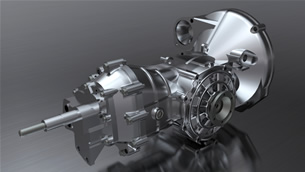 This is one of a series of final images showing a transaxle in various views — all were created in SpaceClaim and rendered in Bunkspeed. Shown here is the Solid view. |
3D design software developer SpaceClaim Corp. (Concord, MA) and Bunkspeed (Los Angeles, CA), the developer of HyperShot photorealistic 3D rendering visualization software, say that their newly announced partnership will “rock the conceptual design industry” — unleashing creativity and decreasing time to market by providing designers with the power and functionality of large 3D modeling and rendering systems — without the expense.
The partnership makes SpaceClaim the first company to offer HyperShot as its standard 3D rendering solution.
| “This is ground-breaking technology that designers and engineers can use to deliver concepts for project review and approval. They aren’t just pictures or CGI. They are real models of the object itself that visualize the product before it exists. These concepts add value and can play an important role in the project.” — Richard Moore, SpaceClaim, VP sales and business development |
"SpaceClaim and Bunkspeed identified a dynamic market opportunity that provides designers and engineers with a unique 3D modeling and rendering tool,” says Philip Lunn, CEO of Bunkspeed. “The connection of these two genre-leading technologies makes for a truly compelling package and builds a valuable bridge from design to marketing."
Adding Value
HyperShot, which integrates into SpaceClaim Professional as an optional module, offers a rendering resolution of 1920 x 1080 that renders the topology of SpaceClaim designs to create precise 3D photorealistic images, not just another picture of them.
The key is said to be that HyperShot is a “click-and-do” tool, which, like SpaceClaim, is engineered to enable users to focus on results rather than on using the software. For SpaceClaim users, this means that they can launch their 3D designs into HyperShot directly and can then create photographic-quality images of their concepts or even prototypes easily. The resulting 3D images can use accurate materials, real-world lighting, and photographic-like detail such as shiny or complex surfaces.
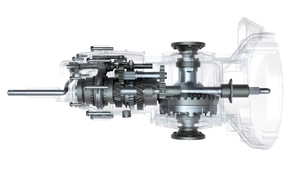 Here the Top Xray view is shown. |
“This is groundbreaking technology that designers and engineers can use to deliver concepts for project review and approval,” says Richard Moore, VP Sales and Business Development, SpaceClaim Corporation. “They aren’t just pictures or CGI ]computer-generated images]. They are real models of the object itself that visualize the product before it exists. These concepts add value and can play an important role in the project.”
And Rhino Makes Three
But this partnership does not stop there.
Robert McNeel & Associates (Seattle, WA) announced a round-trip integration last March between its Rhino freeform 3D modeling tool and SpaceClaim LTX that enables users to open Rhino files directly in SpaceClaim LTX for creating solid geometry. Coupled with the Bunkspeed partnership, this, in SpaceClaim's view, builds “a triple creativity alliance” that delivers a complete design-to-engineering-to-marketing workflow for users.
“SpaceClaim is introducing the conceptual and industrial design communities to tools and partnerships tools that will help users to reach their design potential for the first time by breaking out of the old constraints for workflow and processes,” says Bob McNeel, CEO, Robert McNeel & Associates.
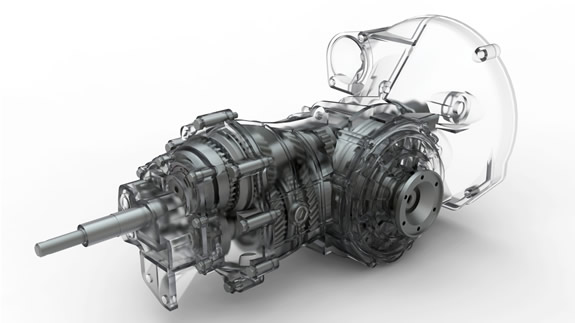 This rendering demonstrates the Frosted Glass view. |
“The exciting new technologies are truly making a difference for users by shaving time from product development cycles and empowering designers to be as creative as they have always wanted to be,” McNeel adds. “These tools free the user to get creative, trying many designs concepts and iterations before presenting the best ones. They make departments more efficient and increase job satisfaction dramatically.”
SpaceClaim LTX and Rhino, says the original release, are naturally compatible and "think alike," offering an environment free of constraints. The combination offers precise modeling and a flat learning curve, improving the product stylist's workflow by giving him/her more control for better product designs and faster time-to-market.
For more information, visit SpaceClaim, Bunkspeed, and/or Robert McNeel & Associates.
Read why DE’s editors chose this as a Pick of the Week.
Watch examples of how SpaceClaim works (an AVI link).
Explore a free trial of SpaceClaim Professional 2008 for 30 days.
Watch the SpaceClaim-Rhino round-trip demo.
View SpaceClaim’s taped webinars, client success stories, use cases, and/or whitepapers.
Read selected previous DE coverage:
“SpaceClaim Launches SpaceClaim Professional 2008,” (April 2008);
“Rhino and SpaceClaim LTX Form Round-trip Integration,” (March 2008).
“SpaceClaim 2007+: A new tool in a mature market that offers a fundamentally different way of working with geometry,” by Al Dean (Dec 2007);
“Bunkspeed HyperShot: An image-rendering system that can bring in 3D CAD data for photorealistic images in seconds,” by Al Dean (Oct 2007).


DE's editors contribute news and new product announcements to Digital Engineering. Press releases may be sent to them via [email protected].
Follow DE
Join over 90,000 engineering professionals who get fresh engineering news as soon as it is published.






About Us · Contact Us · Editorial Team · Advertising · Privacy Policy · Subscriber Services · © 2026 Digital Engineering 24/7 · Peerless Media