Helping design and engineering professionals discover, evaluate and specify technologies and processes that shorten the design cycle and enable success.



May 2026 Special Focus: Artificial Intelligence in Design and Simulation
In this Special Focus Issue, learn about the latest developments in the integration of artificial intelligence into engineering workflows.

Design & Simulation Software Guide 2025
In this Special Issue, Digital Engineering presents its second annual guide to design and simulation software vendors.
At NVIDIA GTC this week, Synopsys announced the progress of its partnership with NVIDIA and showcased several customer case studies that leverage their combined technology.
"Traditional engineering methods can no longer keep pace with the complexity of today's software-defined, intelligent systems," said Sassine Ghazi, president and CEO of Synopsys. "Together with ecosystem partners, Synopsys and NVIDIA are re-engineering how products are designed and developed. By enabling the co-design of electronics and multiphysics, accelerating compute-intensive workloads and applying the power of digital twin for virtual prototyping, we are helping customers engineer the future."
"AI and accelerated computing are fundamentally reinventing engineering — from how products are designed to how they are built and operated," said Jensen Huang, founder and CEO of NVIDIA. "Modern engineering happens inside simulations and digital twins. Together with Synopsys, we are combining NVIDIA CUDA-X, Omniverse, and AI with Synopsys' silicon-to-systems platforms to reimagine engineering for the age of AI and turn growing complexity into a powerful advantage."
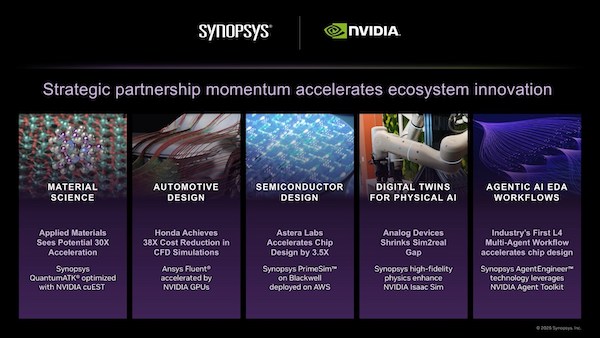
At the event, Synopsys announced several customers that are utilizing NVIDIA GPU-accelerated applications to speed up compute-intensive workloads:
Applied Materials is collaborating with Synopsys and NVIDIA to advance AI and quantum chemistry R&D with accelerated materials modeling. Leveraging Synopsys QuantumATK's new integration with NVIDIA cuEST, early results from Applied Materials show a potential 30X speedup for complex quantum chemistry workloads compared to open-source models running on CPUs. Previously, Applied Materials achieved an 8X simulation speedup leveraging NVIDIA GPUs compared to multi-core CPUs for multi-nanometer amorphous systems featuring approximately 25,000 atoms.
"Applied Materials is working with Synopsys and NVIDIA to accelerate materials engineering innovations that can deliver tremendous improvements in energy-efficient performance of advanced semiconductor devices," said Gary Dickerson, President and CEO of Applied Materials. "This collaboration allows us to significantly reduce the time it takes to run simulations of material behavior at the atomic level, thereby enabling the industry to bring chip design breakthroughs to market faster."
Honda has realized unsteady, large‑scale, high‑fidelity CFD that was previously impractical on CPUs through GPU acceleration on Ansys Fluent fluid simulation software. "We achieved 34x faster computation and 38x cost reduction using four GB200 GPUs compared to 1,920 cloud-based CPU cores," said Yusuke Uda, Assistant Chief Engineer at Honda. "Through close collaboration with Synopsys, Honda is accelerating the migration of its CFD simulations from CPUs to GPUs. This advancement enables us to continue delivering safer, higher‑quality products to our customers at appropriate cost, with consideration for the environment."
Astera Labs achieved a 3.5X speedup running Synopsys PrimeSim using B200 GPU accelerated EC2 instances on AWS compared to CPU-only instances, dramatically shortening design validation cycles and enabling faster time-to-market for next-generation connectivity solutions. According to Synopsys, the seamless access to GPU resources on AWS enables Astera Labs' design teams to "focus on innovation rather than infrastructure setup, further accelerating time-to-market while supporting superior design accuracy."
"The collaboration between Astera Labs, Synopsys, NVIDIA, and AWS is transforming our ability to design advanced blocks for AI connectivity silicon," said Jitendra Mohan, Chief Executive Officer of Astera Labs. "By harnessing the power of NVIDIA B200 GPU-accelerated computing on AWS, we have significantly reduced simulation times and enhanced design accuracy, allowing us to deliver innovative connectivity solutions to the market faster than ever before."
Analog Devices' (ADI) Isaac Sim environment, built on NVIDIA Omniverse libraries, is now augmented with Synopsys physics. ADI is leveraging Isaac Sim to produce high-fidelity simulation assets for its tactile sensing prototype and time-of-flight vision systems, along with digital twins of next-generation robotic dexterity benchmarks. The benchmarks evaluate robotic policies for real applications, such as datacenters and automotive manufacturing. Ansys Mechanical software and AVxcelerate Sensors software bring simulation and reality closer with high-fidelity physics for simulating critical aspects of the test bench, including fiber optic cables and plugs, and sensor depth perception.
ADI's platform will support early adopters, including Kawasaki Heavy Industries, by enabling them to simulate robotic performance and generate synthetic data with greater predictive accuracy. This reduces the need for iterative physical testing and accelerates development. Synopsys' booth at GTC features a demonstration, including a bi-manual robotic arm setup with force, vision, and contact sensing, and a corresponding Isaac Sim visualization.
"Synopsys' multiphysics simulation is a critical enabler of realistic robotic test benches," said Paul Golding, Vice President of Edge AI at ADI. "Together with NVIDIA, we're using that fidelity to create benchmarks and digital twins that make sim‑to‑real transfer practical for real industrial dexterity."
Synopsys is also building an open, secure, hardware accelerated agentic AI stack in collaboration with NVIDIA to cater to use cases from silicon to systems. Synopsys' AgentEngineer multi-agent workflows leverage NVIDIA Agent Toolkit and support NVIDIA NIM inference services and Nemotron models, providing performance and optionality to customers.
At GTC, Synopsys is demonstrating agentic electronic design automation (EDA) workflows, powered by AgentEngineer technology that can orchestrate complex chip design tasks, scale across high-performance environments, and keep engineers in control — accelerating productivity, managing growing design complexity, and redefining how silicon is built in the AI era. Demonstrations will include Synopsys' new industry-first L4 agentic workflow for design and verification.
Sources: Press materials received from the company and additional information gleaned from the company’s website.


DE's editors contribute news and new product announcements to Digital Engineering. Press releases may be sent to them via [email protected].
Follow DE
Join over 90,000 engineering professionals who get fresh engineering news as soon as it is published.






About Us · Contact Us · Editorial Team · Advertising · Privacy Policy · Subscriber Services · © 2026 Digital Engineering 24/7 · Peerless Media