Helping design and engineering professionals discover, evaluate and specify technologies and processes that shorten the design cycle and enable success.



May 2026 Special Focus: Artificial Intelligence in Design and Simulation
In this Special Focus Issue, learn about the latest developments in the integration of artificial intelligence into engineering workflows.

Design & Simulation Software Guide 2025
In this Special Issue, Digital Engineering presents its second annual guide to design and simulation software vendors.
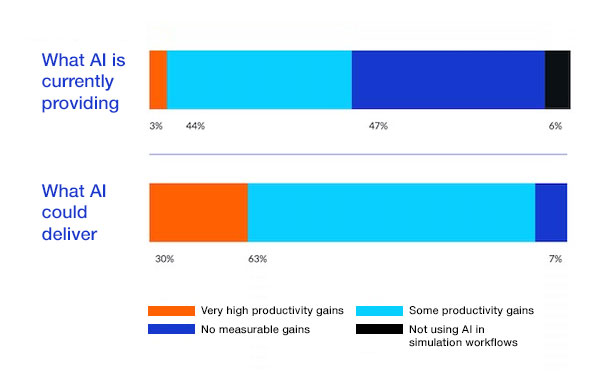
Although artificial intelligence (AI) is expected to produce productivity gains for engineering workflows, only 3% of firms are actually achieving those gains, according to a new report. The State of Engineering AI 2025 report, published by SimScale in partnership with Global Surveyz, identified a significant expectation-execution gap that is holding back AI-driven gains in design and simulation.
“Those that are starting to experiment with AI have high expectations,” said John Wilde, vice president of product at SimScale. “We are starting to see the power it can offer us, and I think it’s going to be massive. Agentic engineering workflows need to double down on democratization, not just on one-shot simulations, but automating massive workflows and optimizations. We don’t just want to run lots of simulations in parallel; we can already do that. AI can provide extrapolation and allow us to work with products in ways that will improve designs.”
The two companies surveyed 300 senior engineering leaders from large enterprises (1,000+ employees) across the U.S. and Europe. These firms expect AI to drive growth as well as improve efficiency, but are often hampered by leadership misalignment, data silos, and out-of-date technical infrastructure.
“Engineering leaders see the potential of AI—but knowing isn’t doing,” said David Heiny, CEO at SimScale. “The challenge is no longer about believing in AI’s promise, but about overcoming the very real systemic blockers that stop teams from scaling it successfully.”
Among the key findings: 93% of engineering leaders expect AI to deliver productivity gains, with 30% anticipating very high gains. But just 3% report achieving that level of impact today.
Organizations using cloud-native simulation tools are 3x more likely to have mature AI programs and 6x more likely to have clean, centralized data, which SimScale says is critical for scaling AI. They are also twice as confident in achieving AI goals within the next 12 months.
55% cite siloed data and 42% cite legacy desktop CAE tools as major obstacles.
42% of CTOs cited resistance to AI adoption within technical teams—but engineer team leaders themselves report resistance just 29% of the time, suggesting technical teams are more open, ready, and motivated to adopt AI than leadership assumes.
Engineering leaders expect AI to fuel greater design innovation (54%), engineering productivity (51%), and faster time to market (47%)—with reduced costs ranking lowest on the list of expected benefits.
Wilde noted that the connection between AI success and cloud-based workflows is, in part, the result of the fact that cloud solutions eliminate data silos. “If you aren’t working in the cloud, then your data is widely distributed and hard to access,” he said.
The 3% of companies that are achieving gains with AI share a few things in common, according to the report:
Modernized Engineering Architecture: They’ve eliminated siloed, desktop-era toolchains in favor of cloud-native platforms. Their engineering data is centralized, accessible, and structured — using open formats and APIs.
Integrated Agentic Workflows: These teams are building and integrating AI agents directly into live workflows — not as bolt-on tools, but as embedded decision-makers at setup, evaluation, and optimization stages.
Fast Path from Prototype to Loop: They test in low-risk settings, but move quickly to real-world, in-the-loop deployment — proving value in weeks, not years.
Treat Data & Models as Infrastructure: They log and version everything — from simulations to models — enabling AI to be scaled, trusted, and portable across their tools and processes.
“This report isn’t just a warning—it’s a path to the winning formula,” Wilde said. “Forward thinking teams are proving that engineering AI can deliver significant changes in innovation and performance. The execution gap for others is not technical feasibility — it’s architectural and organizational readiness. Now it’s about helping those companies make that leap with confidence—before the gap becomes too wide to close.”
Wilde also thinks that AI can have much broader utility in design, beyond the accelerated simulation work that is typically being done right now. “Currently, we are speeding up the last ten percent of the design cycle, and the value is there, but it can be massive if we can improve the entire process,” he said.
For example, AI could be used within CAD to generate new designs based on simulation results. “AI can go further upstream,” Wilde says. “Customers want to present their CAD and their request for proposal, and let the system find some solutions.”
You can download the full report here.


SimScale enables engineering teams to access accurate and fast simulation, on their terms, without compromise. We make engineering simulation technically and economically accessible from everywhere, at any time, and at any scale, in the cloud. We…

Microclimate Simulation for Urban Design
A cloud-native simulation platform allows architects and engineers to simulate and analyze high-fidelity models with complex physics for urban design.

Brian Albright is the editorial director of Digital Engineering.
Contact him at [email protected].

Join over 90,000 engineering professionals who get fresh engineering news as soon as it is published.






About Us · Contact Us · Editorial Team · Advertising · Privacy Policy · Subscriber Services · © 2026 Digital Engineering 24/7 · Peerless Media