Helping design and engineering professionals discover, evaluate and specify technologies and processes that shorten the design cycle and enable success.



Digital Engineering April 2026
In the latest issue of Digital Engineering, we take a look at the latest innovations in design for additive manufacturing, including the use of natural language inputs, social media cosplayers, and AI integration. The issue also includes a feature…

January Special Focus Issue: Design for Additive
In this Special Focus Issue of Digital Engineering, learn about the latest advancements in design for additive manufacturing, including new software tools, additive in automotive, custom medical devices, and more.
The movie Starship Troopers may well have been considered a near parody of the novel, but it did feature an interesting scene in which a wounded combat trooper was patched up using a system that looked remarkably like 3D printing. It turns out this idea may not be so far-fetched.
Building new organs using additive manufacturing (AM) with stem cells gathered from the same patient destined for an operation has been an idea floating around the medical community for some time now. New research conducted by a group of high-tech companies has produced hopeful results for the future of 3D printed organs. The catch is that the printing process can only be completed in a weightless environment.
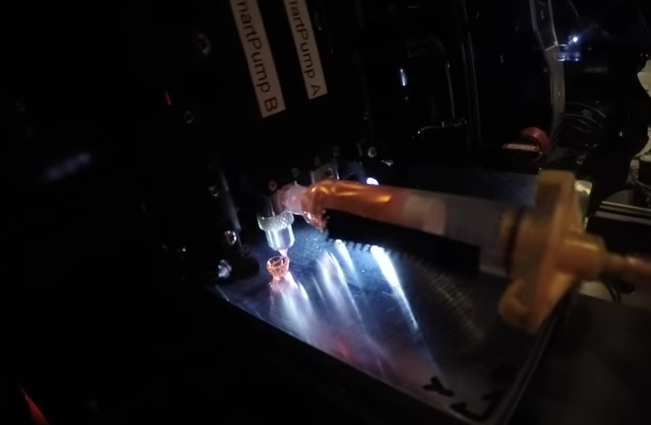 Testing the process of printing hearts in zero g. Screencap via YouTube.
Coordinated by Techshot, the experiment used an AM system provided by nScrypt, and bioink developed by Bioficial Organs Inc. The test was conducted 30,000 ft. up in a Boeing 727 flying a series of parabola arcs that result in weightlessness for 20-30 seconds at a time. During each period of weightlessness, the AM system printed out bits of cardiac and vascular structures.
The absence of gravity may well be the missing key to printing viable human organs.
“On earth, 3D bioprinting requires the use of thick bioinks that can contain chemicals and other materials necessary to provide structural support,” said Stuart Williams, president and CEO, Bioficial Organs, Inc. “But printing tissues in space allows us to use finer print tips and lower viscosity bioinks that contain only the biological materials needed to create a healthy organ. A space-based bioprinter has the potential to be a major game changer for human healthcare.”
Obviously 20-30 seconds of print time isn’t enough time to build complete organs, so the group has made a deal with NASA to conduct further research aboard the International Space Station (ISS). In the event the research proves successful, the deal also allows for commercialized production of organs aboard ISS in the future.
At least initially, the cost of taking a sample from a patient, then transporting that sample to space where a new organ can be printed out is bound to be beyond the reach of most patients. Insurance agencies must already be scrambling to find new ways to deny coverage to Space X launches. Eventually, however, if the procedure proves reliable enough, it isn’t hard to imagine full production facilities in space and routine deliveries that would help reduce the cost.
Below you’ll find a video of the test printing in mid-flight.
Source: Techshot


John Newman is a Digital Engineering contributor who focuses on 3D printing. Contact him via [email protected] and read his posts on Rapid Ready Technology.
Follow DE
Join over 90,000 engineering professionals who get fresh engineering news as soon as it is published.






About Us · Contact Us · Editorial Team · Advertising · Privacy Policy · Subscriber Services · © 2026 Digital Engineering 24/7 · Peerless Media