Helping design and engineering professionals discover, evaluate and specify technologies and processes that shorten the design cycle and enable success.



May 2026 Special Focus: Artificial Intelligence in Design and Simulation
In this Special Focus Issue, learn about the latest developments in the integration of artificial intelligence into engineering workflows.

April 2026 Special Focus Issue: Generative Design
In this Special Focus Issue, Digital Engineering takes a look at how generative design solutions can be used across different types of design problems and with a variety of manufacturing approaches to accelerate design space exploration, and…
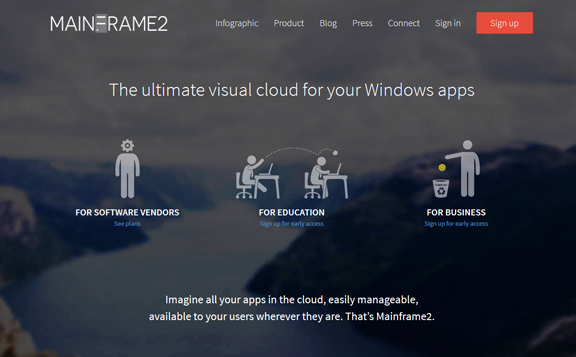 Mainframe2 begins offering cloud services to vendors who want to deliver SaaS products.
Last October, in-between sessions and keynote talks at the Virtualize Conference (Hyatt Regency SFO, Oct 30, 2014), Nikola Bozinovic, founder and CEO of Mainframe2, tapped me on the shoulder.
"We have something to announce soon, but I can't talk about it publicly right now," he said. But the event where this tidbit was shared gave me some clues to what Mainframe2 was planning.
A few weeks later, the announcement came, from the floor of AWS re:Invent 2014, a industry gathering centered around Amazon's cloud services.
In the official announcement, Bozinovic said, "Until now, it's been very difficult for makers of rich graphics apps to expand to the cloud. Mainframe2 makes it easy. We built the first self-service, global, production-ready platform that provides end-to-end support to customers on their journey to SaaS (software as a service). There's nothing like it on the market."
Some, however, may take issues with Bozinovic's claim that there's nothing like it.
Mainframe2 belongs to a class of vendors that have yet to be classified. Their products target software makers looking to transform their desktop offerings (for example, CAD and visualization software titles) into SaaS products, deliverable and billable in the new cloud model. I call them cloud facilitators. A close rival of Mainframe2 may be OTOY's X.IO, described as an app-streaming platform. (For another example of a cloud-facilitator technology, read my previous post on Numecent, which offers "cloud-paging" of applications.)
Bozinovic differentiates Mainframe2 from OTOY and Numecent by saying, "OTOY's X.IO service doesn't seem to be self-service or production-ready; in comparison, Mainframe2 is a robust, fully-automated and scalable platform that's ready for production. We are also 100% focused on professional apps (esp. engineering), in contrast to OTOY's significant focus on games. Numecent is a different type of service, which doesn't provide true platform independence (e.g., Numecent packaged apps can be used only on Windows PCs)."
Mainframe2's plans for software vendors begins at $199 a month. (There's a one-time 100-hour trial plan for $99, but that realistically won't be sufficient to deploy and deliver a program to multiple users.) In addition, Mainframe2 also offers on-demand cloud infrastructure for educational institutions and businesses that want to deploy and deliver virtual desktops to students and employees. Bozinovic revealed that the company has recruited about 20 schools to use its products in the current invite-only Beta program. In 2015 Q1, the company plans to launch an Early Access program with wider access.
Attracted to the promise of cloud commerce, tech giants that used to cater to IT networks and desktop users are refashioning their product lines, or coming up with new offerings, to compete. Penguin Computing, VMWare, NaviSite, Citrix, and NVIDIA many others have already staked claims in the new market. NVIDIA pitches its NVIDIA Grid product line as the IT backbone to cloud service and streaming service providers. Citrix's XenDesktop serves as the software to connect mobile devices to server-hosted workstations. Penguin Computing offers on-demand access to HPC (high-performance computing) clusters to address peak workloads. VMWare's Horizon DaaS (desktop as a service) and NaviSite offer remote workstations that can be check out and deployed on demand for a fee.
One distinguishing characteristic of Mainframe2 is GPU-acceleration, made possible by its partnership with GPU maker NVIDIA. Jeff Brown, vice president and general manager of the Professional Visualization business at NVIDIA, said, "We are thrilled that NVIDIA GRID technology is the key enabler of this new approach to bringing professional graphics software to the cloud." The feature is expected to make a difference in the performance of 3D visualization programs that take advantage of the GPU's coprocessing power.
At Virtualize Conference, Jon Peddie, president of JPR, examined the market-driving forces for virtualization. "CAD doesn't place a big demand on the graphics processor. You don't need a whole lot of GPU processing to do CAD," he said. "But you need an enormous amount of GPU processing in media and entertainment, oil and gas [exploration], and simulation ... CAD, even though it doesn't have a huge lead in graphics demand, does have a lead in virtualization." (To download the slides used by Peddie at the conference, go here.)
Leading a panel on remote desktop adoption, Bob O'Donnell, founder and chief analyst, TECHnalysis, raised a number of questions not easily resolved. "Who actually owns the virtual desktop within IT? We can talk about technology till we're blue in the face, then we'd have to address IT and the turf they own within the organization ... If you're a traditional IT organization, you have a desktop team, network team, server team, storage team, and so on. When you move into virtualization, those walls get blurred."
The blurred boundaries notwithstanding, the use of remote desktops, app streaming, and other variants of virtualization appear to be picking up momentum. As the year drew to a close, Carsten Puls, Mainframe2's chief product officer, wrote, "In 2015, our platform will expand to reach a much broader set of customers including IT departments in education and business who want a better way to deliver and manage their apps. And for our ISV customers you’ll see a big shift from demos to dollars, as they move from easily demoing their Windows apps in a browser to shifting their business models from selling packaged software to delivering true SaaS." (Read Puls's blog post here.)


Kenneth Wong is Digital Engineering's resident blogger and senior editor. Email him at [email protected] or share your thoughts or suggestions at digitaleng.news/facebook.
Follow DE
Join over 90,000 engineering professionals who get fresh engineering news as soon as it is published.






About Us · Contact Us · Editorial Team · Advertising · Privacy Policy · Subscriber Services · © 2026 Digital Engineering 24/7 · Peerless Media