Helping design and engineering professionals discover, evaluate and specify technologies and processes that shorten the design cycle and enable success.



Digital Engineering April 2026
In the latest issue of Digital Engineering, we take a look at the latest innovations in design for additive manufacturing, including the use of natural language inputs, social media cosplayers, and AI integration. The issue also includes a feature…

January Special Focus Issue: Design for Additive
In this Special Focus Issue of Digital Engineering, learn about the latest advancements in design for additive manufacturing, including new software tools, additive in automotive, custom medical devices, and more.
Imagine if the kits could be produced with the really complex parts in one piece, instead of 20, making the construction process that much simpler. That’s basically what additive manufacturing (AM) offers for the production of unmanned aerial vehicles (UAVs). Even when only used for rapid prototyping, AM speeds up the building of a UAV by reducing the number of parts that have to be put together.
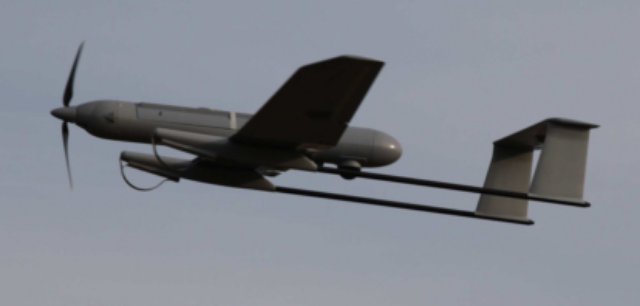
Ease of construction isn’t the only thing AM has going for it for UAV construction. Printed electronics can be combined with 3D printing to build UAVs, and the broad range of available materials can make for lighter UAVs. Survey Copter and Flying-Cam are two different companies that have turned to AM for assistance with UAV construction.
Based in France, Survey Copter, a subsidiary of the European Aeronautic Defence and Space Company N.V. (EADS), builds UAVs to provide surveillance photography and video services over both land and sea. The company had previously outsourced its rapid prototyping needs, but eventually decided to invest in its own systems. This resulted in the purchase of a Dimension Elite and a Fortus 400mc, both from Stratasys.
In addition to prototyping duties, the systems build end-use components, using materials such as thermoplastics polycarbonate, ABS and ULTEM 9085. The latter material not only offers the standard advantages of Stratasys’ Fused Deposition Modeling (FDM) process – also known as material extrusion –but is FST (flame, smoke and toxicity) approved as well.
"That we are able to print production-grade materials such as high-performance FDM thermoplastics like ULTEM, which is qualified for aerospace applications, is a definite plus for our operations," said Jean Marc Masenelli, managing director, Survey Copter. "The Stratasys 3D Printer can produce parts with complex shapes — for us a highly sought after requirement … This specific capability enables us to produce parts of wide-ranging dimensions and hollow forms, as well as full honeycomb structures."
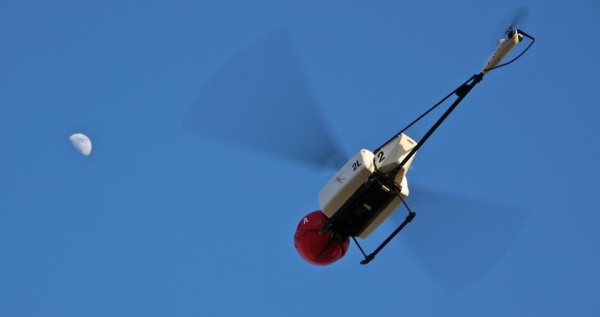
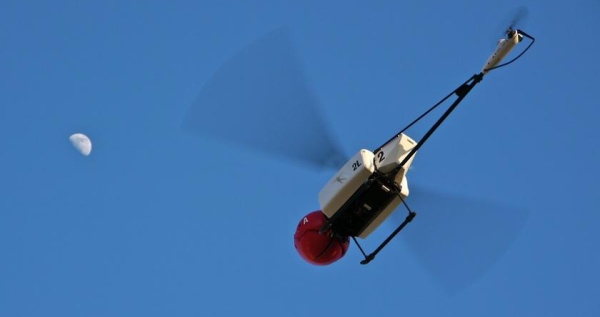
Belgium-based Flying-Cam also builds UAVs with attached cameras, but for use in the entertainment industry as well as for surveillance purposes. You’ve probably seen the company’s UAVs at work assisting photography in the Harry Potter films, and the recent James Bond movies, among others. When the time came to build a new UAV, Flying-Cam decided to leverage the flexibility of AM.
Construction of the company’s next-generation rotary-winged UAV, the Special Aerial Response Automatic Helicopter, or SARAH, employs selective laser sintering and Windform composite materials, which were designed for AM. Parts of SARAH built using 3D printing include the airframe structure, air guide cooling system, tail unit, and main battery connection.
Flying-Cam moved to SLS technology in collaboration with CRP Technology in order to accelerate iteration generation, improve manufacturing time and facilitate production in series. Alongside it allows easier customization of the platform. The requirements were fast iteration process, best ratio between structural strength and weight, acceptable consistent result and opportunity to combine multiples functionalities from one unique part. –Flying-Cam website.
Below you’ll find a video about Flying-Cam’s SARAH.
Sources: PR Newswire, CRP Group


John Newman is a Digital Engineering contributor who focuses on 3D printing. Contact him via [email protected] and read his posts on Rapid Ready Technology.
Follow DE
Join over 90,000 engineering professionals who get fresh engineering news as soon as it is published.






About Us · Contact Us · Editorial Team · Advertising · Privacy Policy · Subscriber Services · © 2026 Digital Engineering 24/7 · Peerless Media