Helping design and engineering professionals discover, evaluate and specify technologies and processes that shorten the design cycle and enable success.




Digital Engineering April 2026
In the latest issue of Digital Engineering, we take a look at the latest innovations in design for additive manufacturing, including the use of natural language inputs, social media cosplayers, and AI integration. The issue also includes a feature…

January Special Focus Issue: Design for Additive
In this Special Focus Issue of Digital Engineering, learn about the latest advancements in design for additive manufacturing, including new software tools, additive in automotive, custom medical devices, and more.
A University of Glasgow research team has made steps toward using 3D printers as home chemical fabricators. The team used a 3D printer and open source CAD software to create vessels for chemical reactions made from a polymer gel. The gel sets at room temperature, creating what the researchers have dubbed “reactionware.”
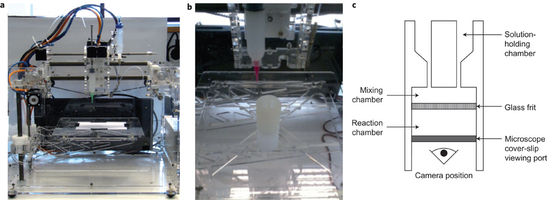
By adding other chemicals to the gel as it is printed, the team is able to make the vessel part of the reaction process, something not usually seen outside of industrial chemical engineering. This could allow for the process to be replicated in small labs or even at home. This is the sort of democratization of manufacturing that is the ideal for the future of additive manufacturing (AM).
“It’s long been possible to have lab materials custom-made to include windows or electrodes, for example, but it’s been expensive and time-consuming,” says Professor Lee Cronin, Gardiner Chair of Chemistry. “We can fabricate these reactionware vessels using a 3D printer in a relatively short time. Even the most complicated vessels we’ve built have only taken a few hours.”
“By making the vessel itself part of the reaction process, the distinction between the reactor and the reaction becomes very hazy,” added Cronin. “It’s a new way for chemists to think, and it gives us very specific control over reactions because we can continually refine the design of our vessels as required.”
While Cronin and his team admit their research into this new application of 3D printing is still in the very early stages of development, Cronin has a vision for the future of medicine that very nearly eliminates the need for drugstores and could bring badly needed drugs to anyplace with AM capabilities.
We could even see 3D printers reach into homes and become fabricators of domestic items, including medications. Perhaps with the introduction of carefully-controlled software ‘apps,’ similar to the ones available from Apple, we could see consumers have access to a personal drug designer they could use at home to create the medication they need. –Professor Lee Cronin
The team has written a paper on their research which was published in Nature Chemistry.
Below you’ll find a video that looks at another medical use of AM.
Source: Phys.Org


John Newman is a Digital Engineering contributor who focuses on 3D printing. Contact him via [email protected] and read his posts on Rapid Ready Technology.
Follow DE
Join over 90,000 engineering professionals who get fresh engineering news as soon as it is published.






About Us · Contact Us · Editorial Team · Advertising · Privacy Policy · Subscriber Services · © 2026 Digital Engineering 24/7 · Peerless Media