Helping design and engineering professionals discover, evaluate and specify technologies and processes that shorten the design cycle and enable success.


Alert!
Digital Engineering ceased publication on July 1, 2026. This website remains available as an archive of engineering content.
For inquiries or information, please email [email protected].

Digital Engineering April 2026
In the latest issue of Digital Engineering, we take a look at the latest innovations in design for additive manufacturing, including the use of natural language inputs, social media cosplayers, and AI integration. The issue also includes a feature…

January Special Focus Issue: Design for Additive
In this Special Focus Issue of Digital Engineering, learn about the latest advancements in design for additive manufacturing, including new software tools, additive in automotive, custom medical devices, and more.
Geomagic software has been used for everything from helping to ensure the safety of the space shuttle to making invisible aligners that take away the stigma caused by traditional orthodontic braces. But perhaps the most life-affirming application of Geomagic software has come out of an engineer-physician team working at Shriners Hospital for Children in Springfield, Mass.
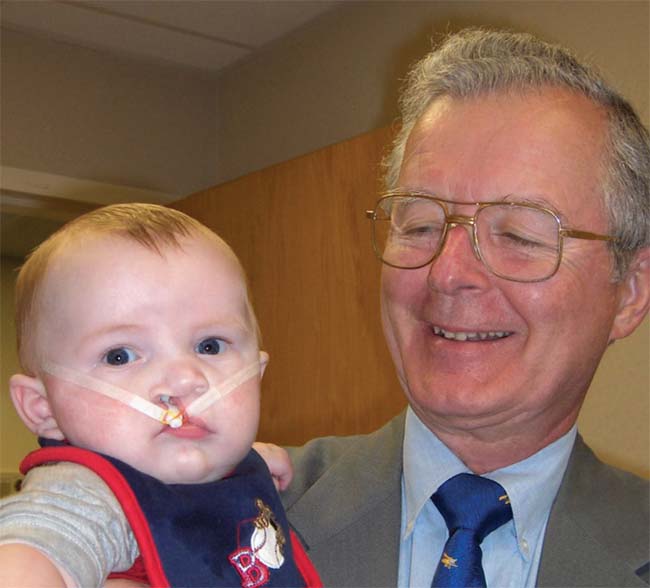 Dr. Philip Stoddard and his patient near the end of the presurgical treatment with the last of a series of treatment appliances designed using Geomagic software from scans of dental impressions. |
The engineer, Beth Roscoe, and the physician, Philip Stoddard, are using Geomagic software to bring smiles to children’s faces, and by extension, the faces of their families. With the help of 3D scanning technologies, Roscoe and Stoddard have developed a new treatment for severe cleft lip and palate that reduces the cleft width before surgery without inhibiting upper-jaw growth.
Like many breakthroughs, this one came through a combination of vision, innovation, great technology, and a fair amount of luck. The good fortune came from a chance encounter in a hospital cafeteria, and the friends Stoddard has made through his hobby, flying gliders.
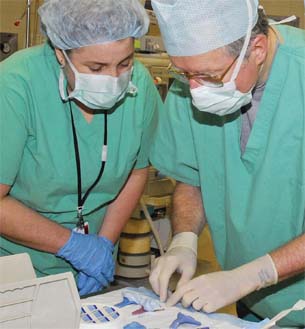 Prosthetics researcher Beth Roscoe and surgeon Dr. Philip Stoddard of Shriners Hospital for Children with dental impressions of one of the first patients to receive the new treatment centering around non-invasive appliances modeled with Geomagic software. |
Searching for a Better Way
The search for a new treatment began a few years ago after Stoddard returned from a workshop on Naso-Alveolar Molding (NAM)—one of the two major presurgical treatment methods for babies born with severe cleft lips and palates.
NAM is labor intensive and requires a dental lab and onsite orthodontic staff. Results can vary depending on the skill of the orthodontist administering the treatment. The other treatment method, DentoMaxillary Appliance (DMA), also has drawbacks. It is invasive, requiring surgical pinning of an appliance to the roof of the mouth under anesthesia, and daily screw tightening by caretakers. Some physicians think it might also impede jaw growth.
Stoddard thought there must be a better way. He believed that computers might be the key to better presurgical treatment for wide cleft lip and palates, but he didn’t know about the technology to make it happen. That’s when the first bit of serendipity took place.
Stoddard was having lunch in the Shriners Hospital cafeteria when he had a chance meeting with Roscoe, a resident in prosthetics. During the course of their conversation, Stoddard learned that Roscoe was previously a software engineer who developed CAD systems.
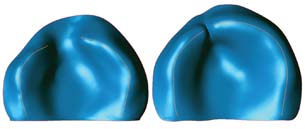 A close up of the occlusal view for the first and last appliances modeled in Geomagic software. |
A New Methodology Takes Shape
A light bulb went on in Stoddard’s head. He asked Roscoe to develop a proposal for using CAD/CAM for presurgical treatment of cleft lip and palate. She accepted the challenge.
Roscoe proposed scanning a plaster model of a patient’s cleft palate to obtain 3D shape data, modeling a corrected palate, interpolating between the model at the beginning and the end of the treatment to reduce cleft width while accommodating for growth, and then using a rapid-prototyping machine to produce a series of corrective appliances.
“The serial appliance approach was a way to circumvent the need to modify a single appliance every week,” says Roscoe. “Each appliance in the series would represent the manual modification used in the other methods. I knew it wasn’t an A-to-B linear path of treatment. The appliances needed to morph to accommodate changes in size, shape, and even configuration.”
Right Tool at the Right Time
With the procedure outlined, the main issue was choosing the software for 3D modeling. Roscoe thought she might have to use the scan data as a reference and create the CAD model from scratch.
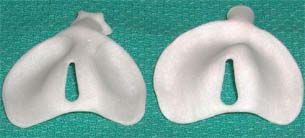 The RP-manufactured first and last appliances in a treatment series modeled with Geomagic. |
She gave the proposal to Stoddard, who ran it by Peter Fuss—an electrical engineer, fellow glider enthusiast, and friend—during a ski vacation. Stoddard didn’t know at the time that Fuss was on the Geomagic board of directors. Fuss thought that Geomagic would be ideal for the project. After the vacation, Fuss arranged for Roscoe to obtain Geomagic Studio, and she began learning how to use it.
“I didn’t have any formal training,” says Roscoe. “I muscled through and got a good command of the software on my own, with the help of some online tutorials from Geomagic.” Her initiation with Geomagic confirmed what Fuss had suspected.
“Geomagic was the perfect solution to our very specific need: to be able to create and easily manipulate detailed 3D models from point clouds,” says Roscoe. “It enables us to produce highly accurate appliances that provide a custom-fit for each baby, and a means of specifying each patient’s unique 3D prescription.”
Putting It All Together
The final piece of the puzzle—how to manufacture the series of individualized appliances—involved Bob Morehardt, another of Stoddard’s technology-minded glider friends.
Although Stoddard didn’t know it when they first met, Morehardt is owner of RMB Tool (formerly Mor-Tech), the first rapid prototyping service bureau in the Northeast United States to use selective laser sintering (SLS) systems. When Roscoe found out about Morehardt, she thought he could provide the manufacturing part of the solution.
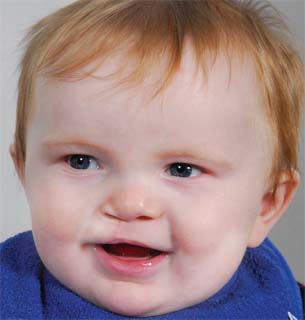 This is the happy patient two months after his cleft palate surgery. |
Roscoe and Stoddard met with Morehardt and came away confident that they could use RMB Tool’s SLS systems from 3D Systems to create the dozen or more appliances needed to serially mold a patient’s gums into a more normal position, while allowing the palate to grow naturally.
After outlining the treatment methodology and determining the technology tools, it was time to put the new regimen to the test. This required permission from the Institutional Review Board (IRB), the medical equivalent of the Federal Aviation Administration (FAA).
The Proof is in the Smile
The IRB approved the Roscoe-Stoddard plan and treatment for the first baby began in early March 2008. The procedure is fairly simple. Roscoe establishes the initial palate shape by scanning a mold of the child’s lip and palate. Initially a CMM system was used for this; now Roscoe uses a ShapeGrabber 3D laser scanner for data capture. Within Geomagic, Roscoe defines the desired final palate shape (allowing for growth), creates the intermediate steps, and converts each palate shape into a digital model of the appliance at the different intermediate steps. Finally, the series of appliances is manufactured with an additive system.
Treatment typically begins within the first month of the baby’s life and lasts 10 to 15 weeks, after which lip repair surgery is performed by the plastic surgeon. Two babies have so far completed the process. Treatment was tolerated well in both cases and the physical transformations are stunning.
Besides the dramatic differences in physical appearance, other benefits of the new procedure are that it is less invasive (appliances are not pinned to the roof of the mouth); it is less labor intensive; there’s no anesthesia risk for appliance insertion (anesthesia is not used); software enables more control in sculpting the corrected palate and gum shape prior to lip repair; and it is an accurate, repeatable process.
“The treatment couldn’t have gone any better,” says Rose Kellogg, grandmother of the second baby treated. “We wanted something less invasive and this was perfect. He is sensitive but he got through it nicely. He was treated as an individual and our whole family was given special treatment by everybody at Shriners Hospital.”
The new presurgical treatment offers a couple of important precedents from a physician’s perspective.
“Never before have we been able to accurately accommodate the baby’s growth as part of presurgical treatment,” says Stoddard. “And, for the first time, we can offer a less-invasive treatment without the need for onsite orthodontic staff.”
Roscoe and Stoddard hope to make the new methodology available to other cleft clinics in the future. There’s also great potential for using the process in other areas of orthopedic and reconstructive medicine.
“Physicians that have been introduced to the capabilities of Geomagic have a new perspective in problem-solving,” says Roscoe. “I believe we are just scratching the surface of how this technology can be used to help patients in a wide variety of ways. It’s very exciting!”
More Info:
3D Systems
Shriners Hospital for Children
Bob Cramblitt is principal of Cramblitt & Company in Cary, NC, and writes about design, engineering, and IT technologies. Send e-mail about this article to [email protected].


DE's editors contribute news and new product announcements to Digital Engineering. Press releases may be sent to them via [email protected].
Follow DE






About Us · Contact Us · Editorial Team · Advertising · Privacy Policy · Subscriber Services · © 2026 Digital Engineering 24/7 · Peerless Media