Helping design and engineering professionals discover, evaluate and specify technologies and processes that shorten the design cycle and enable success.



Digital Engineering April 2026
In the latest issue of Digital Engineering, we take a look at the latest innovations in design for additive manufacturing, including the use of natural language inputs, social media cosplayers, and AI integration. The issue also includes a feature…

January Special Focus Issue: Design for Additive
In this Special Focus Issue of Digital Engineering, learn about the latest advancements in design for additive manufacturing, including new software tools, additive in automotive, custom medical devices, and more.
Voxeljet has developed an inkjet 3D printer intended for continuous printing. The printer uses a conveyor belt to move objects as they are being printed. Objects that start in the build area eventually pop out the other side of the machine, ready for post-production work or packaging.
The innovative system design allows unprecedented performance to be achieved. While printing is carried out on one side of the system, unpacking can take place synchronously on the other. This is all done without operation being interrupted. It raises production, in particular patternless small batch production of moulds and models for metal casting, to a higher dimension of speed and cost-efficiency. –Dr. Ingo Ederer, CEO of Voxeljet
The research team at Voxeljet says the 3D printer will have a build envelope of 500 x 500 mm (19.69 in.), but the process also allows for nearly any length of object to be built. The company has designed this particular system for creating molds, but, assuming it all works out, I don’t see any reason other objects couldn’t be created using different printing processes.
According to Voxeljet, other advantages of the system include an increase in the amount of reusable printing materials and the all-in-one nature of the machine that eliminates the need for an unpacking area. The slightly tilted build area also allows the print head to move more quickly, speeding up build times. The resolution of the new printer is set at 600 dpi, with a layer thickness of 150 µm to 400 µm.
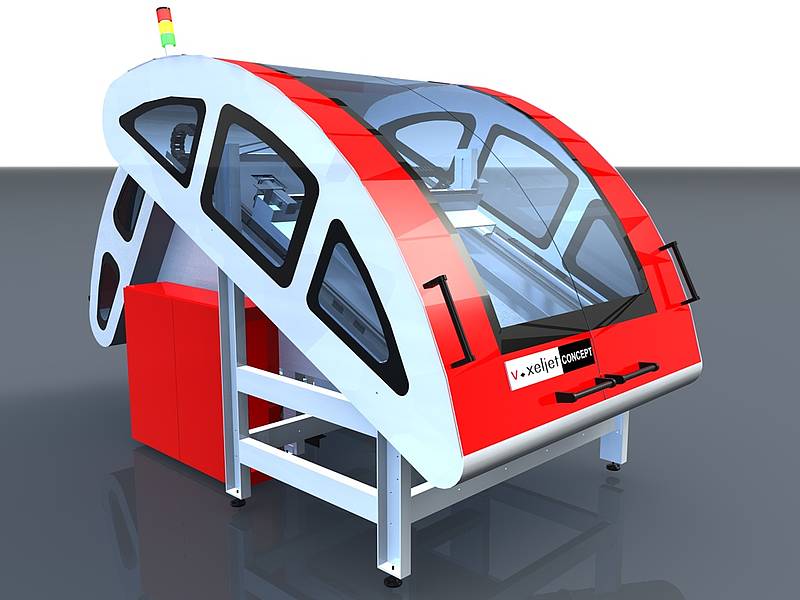
The continuous 3D printer isn't available yet, though.
"At the present time we are working flat out on refining the system for series production," says Dr. Ederer. "Customers should be taking delivery of the first machines by the beginning of next year at the latest. The new machine concept is set to become a real highlight in our wide-ranging portfolio of standard and high-definition printers. With this system we now have a unique product range and can offer customers from a variety of industries the perfect solution for any application.”
Below you’ll find a video that explains the process.
Source: Voxeljet


John Newman is a Digital Engineering contributor who focuses on 3D printing. Contact him via [email protected] and read his posts on Rapid Ready Technology.
Follow DE
Join over 90,000 engineering professionals who get fresh engineering news as soon as it is published.






About Us · Contact Us · Editorial Team · Advertising · Privacy Policy · Subscriber Services · © 2026 Digital Engineering 24/7 · Peerless Media