Helping design and engineering professionals discover, evaluate and specify technologies and processes that shorten the design cycle and enable success.



May 2026 Special Focus: Artificial Intelligence in Design and Simulation
In this Special Focus Issue, learn about the latest developments in the integration of artificial intelligence into engineering workflows.

April 2026 Special Focus Issue: Generative Design
In this Special Focus Issue, Digital Engineering takes a look at how generative design solutions can be used across different types of design problems and with a variety of manufacturing approaches to accelerate design space exploration, and…
Manual wheelchairs were first used in the United States around the time of the Civil War, and their design hasn’t changed much since then. Even with new lightweight materials that reduce the weight of wheelchairs, users still often suffer from shoulder pain and find it tough going on inclines and uneven terrain.
Gearing Up
Magic Wheels (Seattle, WA) had the idea to add a second gear, much like the gears on a bicycle. MAGICWHEELS feature a two-speed geared drive that reduces the effort needed to negotiate slopes and rugged surfaces. The quick-release wheels can be attached to existing wheelchairs.
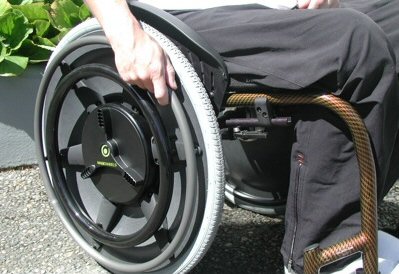 |
| MAGICWHEELS provides two gears to make it easier for users to handle inclines and rough surfaces. |
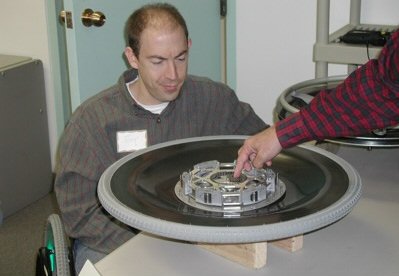 |
| The gear mechanism is incorporated into the wheel itself. |
The strain of propelling a wheelchair can cause severe and chronic shoulder pain. Close to 80% of manual wheelchair users report shoulder pain. A University of Maryland study indicates that use of the Magic Wheels chair may reduce shoulder pain in long-term wheelchair users. Another advantage is that the gear system is purely mechanical, with no batteries that can run down and strand the user. Suggested retail price for a set of MAGICWHEELS is $4,995.
Digital Prototyping
The company used Autodesk’s Inventor software in developing the Magic Wheels product, which evolved over a nine-year period. Autodesk honored the company with its Inventor of the Month award in August 2007.
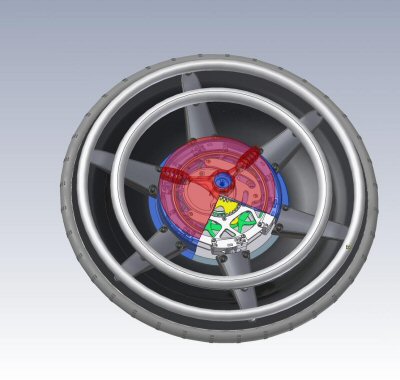 |
| Magic Wheels designers use Autodesk Inventor for product design. |
"There has never been a more exciting time to be an inventor than now," said Robert "Buzz" Kross, senior vice president of Autodesk Manufacturing Solutions. "Companies like Magic Wheels are using digital prototyping to refine the invention process, leveraging software that is as groundbreaking as their ideas."
Innovation History
Magic Wheels was co-founded in 1996 by Steve Meginniss, who also invented or developed the Sonicare toothbrush, the Clarisonic skin care system, and the Quinton Quik-Prep electrodes used in stress testing. The company has received more than $2.9 million in funding, including $1.65 million from the NIH and $114,000 from the Washington Technology Center, which has funded strength, endurance and environmental testing at the University of Washington's Materials Science Lab.
Sources: Press materials received from the company and additional information gleaned from the company's website.


DE's editors contribute news and new product announcements to Digital Engineering. Press releases may be sent to them via [email protected].
Follow DE
Join over 90,000 engineering professionals who get fresh engineering news as soon as it is published.






About Us · Contact Us · Editorial Team · Advertising · Privacy Policy · Subscriber Services · © 2026 Digital Engineering 24/7 · Peerless Media