Helping design and engineering professionals discover, evaluate and specify technologies and processes that shorten the design cycle and enable success.



May 2026 Special Focus: Artificial Intelligence in Design and Simulation
In this Special Focus Issue, learn about the latest developments in the integration of artificial intelligence into engineering workflows.

April 2026 Special Focus Issue: Generative Design
In this Special Focus Issue, Digital Engineering takes a look at how generative design solutions can be used across different types of design problems and with a variety of manufacturing approaches to accelerate design space exploration, and…
"AI isn't all about the sexy stuff that one hears about, like self-driving cars. There are some simple, pragmatic things one can do with it," Carlsson pointed out. "We worked with a global customer to solve money laundering problem, to lower false positives dramatically."
Somar Velayutham, the AI evangelist for NVIDIA, offered another example of seemingly mundane but practical use of AI. "At NVIDIA cafe, we use an image-recognition system. So if you just leave your soup, salad, and lunch in front of it, it tells you what the calories are and what the price is," he added.
Recently in the engineering sector, design and engineering tool providers like Autodesk and Dassault Systemes have begun exploring ways to incorporate AI into their 3D modeling and simulation products. Leading microprocessor makers -- Intel, NVIDIA, and AMD -- also stand to benefit from the growth in AI, as the process of developing AI-driven systems require tremendous processing power.
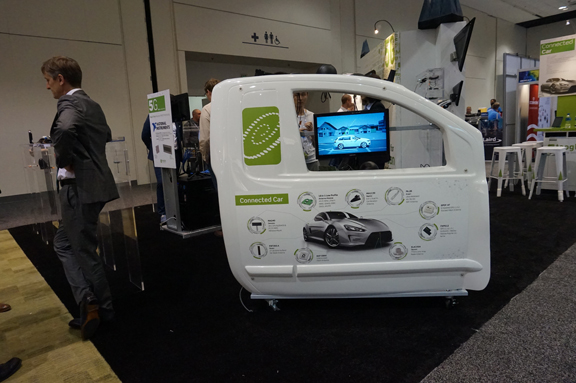
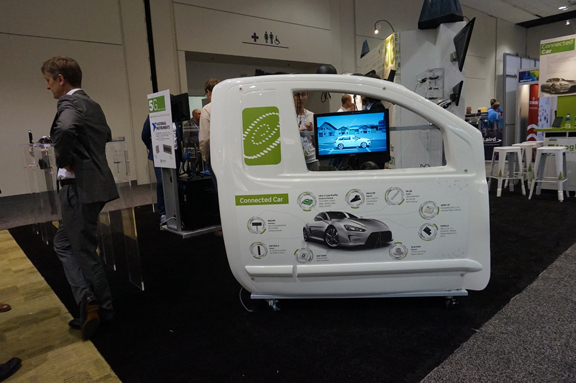 The self-driving car is at the intersection of connectivity, AI, and engineering. It's part of the discussions at the World Mobile Congress America (WMCA) 2017.
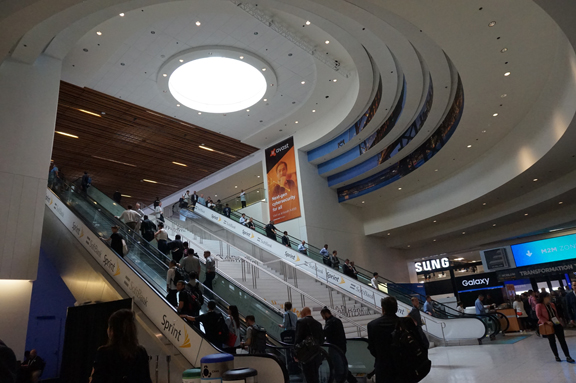 SanFrancisco's Moscone Convention Center plays host to the World Mobile Congress America (WMCA) 2017.
The moderator, Paul Hsiao from Canvas Ventures, posed a question to the panelists: What is AI, and what is not AI?
Danny Lange, VP of AI and machine learning at Unity Technologies, said, "It's not one thing. It's an aggregate of smart achieved by deep learning and machine learning."
"I would argue something like [Microsoft's virtual personal assistant] Alexa is not AI. Most of it are connectivity, voice activation, and programming. I think AI starts with machine learning, but also has the ability to self-adapt," said Kris Bondi, CMO of Neura.
"For me, there's a difference between a logic-driven system and an AI-driven system. AI has the ability to evolve and become smarter. AI is a process. It's not a switch you turn on and everything becomes AI," said Velayutham.
AI-like tools now appear in topology optimization and generative design software, which can suggest the best (or optimal) geometry based on the loads, stresses, pressures, and material characteristics provided by the designer. Some of the speakers above might argue these tools are not yet AI, since they operate based on time-tested finite element analysis (FEA) and computational fluid dynamics (CFD) technologies to identify the best material and mass distribution to arrive at the so-called optimal shape.
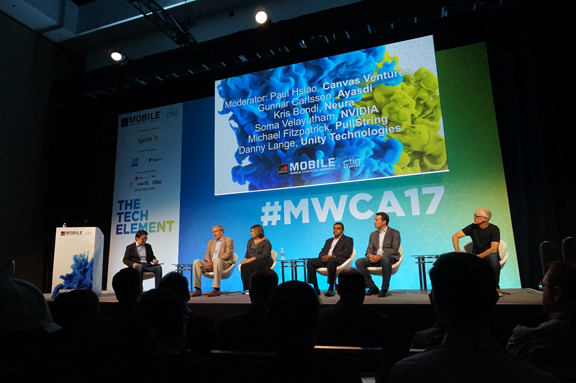 Panel discussion on AI at the World Mobile Congress America (WMCA) 2017.
 A conference attendee looks for a charging station at the World Mobile Congress America (WMCA) 2017.
At Uber, Lange shepherded the program to build "the world’s most versatile machine learning platform to support Uber’s hyper growth," according to Lange's executive bio at Unity. During the discussion at WMCA, he pointed out, "Data is one of the biggest challenges -- the quality of the data and the clean labels that identify the source and characteristics of the data."
In the case of the self-driving car, the car's ability to distinguish the different types of objects it senses and sees -- ranging from tress and traffic signs to ambulances and police cars nearby -- depends largely on the quality of the data used to train the vehicle's decision-making algorithm.
"When you see a self-driving Uber car in San Francisco, it's not like something coded that car and now they're out testing it. Uber had to collect the data first. That's one purpose for driving around the city. Then, back at the office, someone had to manually label the data to help the computer understand what it's looking at," explained Lange. "Right now, we need a lot of human labor to label the data collected for the AI system to train. That is the bottleneck."
As often, discussion of AI stirred up anxieties of its impact on the human workforce.
"AI's going to enable a lot of jobs. People tend to view AI negatively. I think it's more positive than negative. Risky jobs, like cleaning Uranium, could be done by AI-powered robots," noted Velayutham.
The human-machine relationship may ultimately be defined by the objective function or the goal of the AI system. In a computer game, for example, the objective function of the AI is usually to present the human player with a series of increasingly difficult obstacles. But that doesn't necessarily need to be the case. Lange pointed out, "It could also be programmed to keep the player alive in the game for a set amount of time for enjoyment."
Carlsson pointed out, "The real objective function [of AI systems] is the welfare of humans, in a general sense." Many humans hope this objective function remains consistent as AI acquires the ability to evolve.


Kenneth Wong is Digital Engineering's resident blogger and senior editor. Email him at [email protected] or share your thoughts or suggestions at digitaleng.news/facebook.
Follow DE
Join over 90,000 engineering professionals who get fresh engineering news as soon as it is published.






About Us · Contact Us · Editorial Team · Advertising · Privacy Policy · Subscriber Services · © 2026 Digital Engineering 24/7 · Peerless Media