Helping design and engineering professionals discover, evaluate and specify technologies and processes that shorten the design cycle and enable success.



May 2026 Special Focus: Artificial Intelligence in Design and Simulation
In this Special Focus Issue, learn about the latest developments in the integration of artificial intelligence into engineering workflows.

April 2026 Special Focus Issue: Generative Design
In this Special Focus Issue, Digital Engineering takes a look at how generative design solutions can be used across different types of design problems and with a variety of manufacturing approaches to accelerate design space exploration, and…
While consumer adoption of extended reality (XR) has seemingly plateaued, the technology is making inroads into product design and visualization applications. Thanks to its ability to intuitively visualize, design and modify products with ease, design and engineering have emerged as the second most popular applications of XR (after training and education), being used by 38% of firms in 2018, reports VR Intelligence.

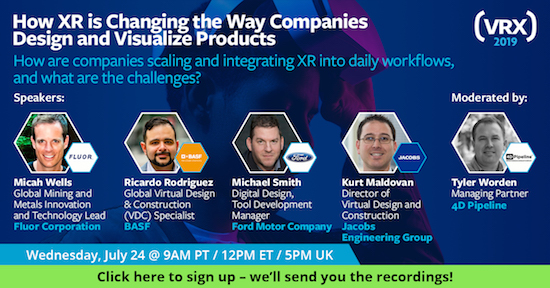
On July 24, an expert panel of speakers addressed the topic “How XR is Changing the Way Companies Visualize and Design Products” in a live webinar. Moderator Tyler Worden (Managing Partner, 4D Pipeline) was joined by Ricardo Rodriguez (Global Virtual Design & Construction Specialist, BASF), Kurt Maldovah (Director of Virtual Design and Construction, Jacobs Engineering Group), Michael Smith (Digital Design, Tool Development Manager, Ford Motor Company) and Micah Wells (Global Mining and Metals Innovation and Technology Lead, Fluor Corporation). The webinar explored the latest applications of XR that are transforming the fields of product engineering, design and visualization, how companies can extract the greatest ROI from XR, and where future opportunities may lie.
Examples of successful XR applications are increasingly making headlines. Exploring how the technology could ameliorate special reasoning for engineers, Accenture Labs built a proof-of-concept car seat, placing design files into a headset so that viewers could understand how the design would render in the real world. Any changes to the CAD design were instantly replicated through the headset as a 3D Digital Double, allowing for easier, safer and faster modification of the product.
AR also works well as a replacement for physical manuals, allowing technicians to focus on their tasks but with the information they need available. For example, engineers at NASA are currently using augmented reality (AR) headsets to build spacecraft, with models of parts and labels being overlaid on completed sections of the spacecraft and information like torqueing instructions being displayed in the relevant places. Lockheed is similarly extending its use of AR after seeing some dramatic effects during testing, after finding that technicians needed less time to learn a new task or to understand and perform processes like drilling holes and twisting fasteners.
However, while XR may be the natural next step for product designers and engineers, its novelty and expense mean there are no accepted best practices, as well as plenty of opportunities to overspend and underdeliver. According to VR Intelligence, however, “the successful deployment of XR now could be the difference between success and failure in the future.”
You can access the webinar recordings here. The session explored which industries are currently using XR, where VR or AR are best suited for us, how companies are scaling and integrating XR into daily workflows, and how to realistically measure XR return on investment.
The webinar was run in association with VR Intelligence’s upcoming VRX Conference & Expo, taking place December 12-13, 2019, at the Hyatt Regency San Francisco Airport Hotel.
Source: VR Intelligence


DE's editors contribute news and new product announcements to Digital Engineering. Press releases may be sent to them via [email protected].
Follow DE
Join over 90,000 engineering professionals who get fresh engineering news as soon as it is published.






About Us · Contact Us · Editorial Team · Advertising · Privacy Policy · Subscriber Services · © 2026 Digital Engineering 24/7 · Peerless Media