Helping design and engineering professionals discover, evaluate and specify technologies and processes that shorten the design cycle and enable success.


Alert!
Digital Engineering ceased publication on July 1, 2026. This website remains available as an archive of engineering content.
For inquiries or information, please email [email protected].
May 2026 Special Focus: Artificial Intelligence in Design and Simulation
In this Special Focus Issue, learn about the latest developments in the integration of artificial intelligence into engineering workflows.

Design & Simulation Software Guide 2025
In this Special Issue, Digital Engineering presents its second annual guide to design and simulation software vendors.
Dear Desktop Engineering Reader:
Years ago, I was in New Orleans at a trade show. I left my hotel one morning and witnessed two guys determined to communicate. One was a Japanese businessman looking for the convention center, the other a Cajun guy who knew how to get there. Both had accents thick enough to cut with a knife and a knack for unclear word choices. It took them forever to get their intentions understood. That's how communications work in many companies. Design and production have to communicate, but they do not quite speak the same language. It does not have to be that way.
Applied Geometrics—AGI for short—knows you can get your local and global design-through-production teams communicating clearly and concisely. You just have to know how, and knowing how starts with making GD&T (geometric dimensioning and tolerancing)—specifically ASME Y14.5—your language of engineering expression. Just like mathematical expression is understood by practitioners worldwide, ASME Y14.5 is a practical, proven engineering expression standard leveraged by manufacturers large and small everywhere.

The benefits of GD&T all boil down to this: Clear, concise, and standardized communication between design and production equals a higher return on investment. Why? How? Because scrap, rework, and those maddening day- or week-long delays because somebody cannot figure out what the blueprint is saying are minimized when everyone uses the same nomenclature to express their intentions. Or, as AGI puts it, ASME 14.5 means that your “production matches design and design matches function.”
So, what does AGI do? For more than 20 years, they've helped companies like Alcoa, Johnson & Johnson, Northrup, and Harley-Davidson implement GD&T in their process. AGI offers open and private on-site seminars, customized education, consulting, project management, mentoring, and now self-paced e-learning training. If you need to know how to implement GD&T in your organization, AGI has developed the program to help you get you there.
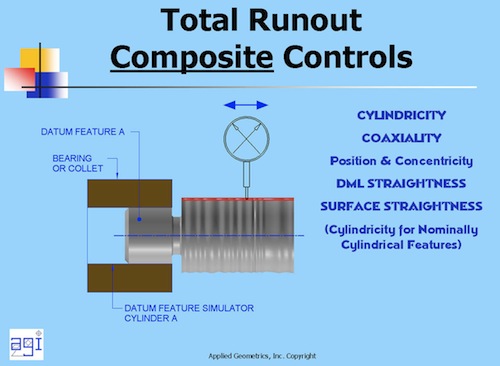
Today's Check It Out provides a few minutes of introduction to one of the online e-learning courses. It's clear, concise, and leaves you ready to learn more.
Your process probably bristles with all sorts of Lean this and Six that methodologies to ensure efficiencies, but not one of them will return its full potential if your design and production teams don't speak the same language. GD&T is the language of engineering expression, and AGI can teach you how to express yourself with it. GD&T is the missing link in your design through manufacturing chain. So, hit the link over there and begin exploring how, properly implemented, GD&T can return measurable, time-, and money-saving production efficiencies.
Thanks, pal. — Lockwood
Anthony J. Lockwood
Editor at Large, Desktop Engineering


Anthony J. Lockwood is Digital Engineering's founding editor. He is now retired. Contact him via [email protected].
Follow DE






About Us · Contact Us · Editorial Team · Advertising · Privacy Policy · Subscriber Services · © 2026 Digital Engineering 24/7 · Peerless Media