Helping design and engineering professionals discover, evaluate and specify technologies and processes that shorten the design cycle and enable success.


Alert!
Digital Engineering ceased publication on July 1, 2026. This website remains available as an archive of engineering content.
For inquiries or information, please email [email protected].

Digital Engineering April 2026
In the latest issue of Digital Engineering, we take a look at the latest innovations in design for additive manufacturing, including the use of natural language inputs, social media cosplayers, and AI integration. The issue also includes a feature…

January Special Focus Issue: Design for Additive
In this Special Focus Issue of Digital Engineering, learn about the latest advancements in design for additive manufacturing, including new software tools, additive in automotive, custom medical devices, and more.
Dear Desktop Engineering Reader:
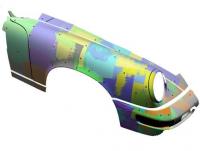 |
You know Konica Minolta well for its top-shelf line of 3D scanners for the range of reverse engineering, shape measurement, and 3D data capture applications for whatever large or small scheme an engineer, manufacturer, researcher, or even student may think up. What you may not know—it's kind of new and I just became aware of it—is that Konica Minolta has a 3D Scanning Services division where its trained engineers and technicians can do the scanning for you.
This is not just a service bureau that does a quick scan of your widget and dumps a point cloud on you. It is the full monty: reverse engineering, 3D inspection, metrology, and scanning complex items for you tool and die people. Engineering services for new product development, mechanical engineering, and industrial, ergonomic, and even packaging design are offered. Konica Minolta can do complete turnkey projects at your location if you want. And its facility has a metrology lab with a temperature-controlled (20°C ±1°), 120- x 100-ft. bay for scanning big stuff like cars or boats.
Capabilities go on from there. For example, these guys can scan in, say, your turbine blade and return a SolidWorks model or any other major MCAD model if you need that. (Yes, you can get the point cloud if you want to fuss with it from there.) They can compare measurement data to your CAD model or to a 3D scan of a proof part then provide you a comprehensive inspection report.
And, of course, the Konica Minolta 3D Scanning Services division uses for your application the same technology it developed for its VIVID and RANGE series of 3D scanners—the equipment that you probably wish you had on site. This may be the next best thing for you plus you get access to experienced experts running the equipment.
You can check out the full range of what the Konica Minolta 3D Scanning Services division has to offer via this link. If you're ready to submit an RFQ, here's a link to the RFQ submission form.
Thanks, Pal. -- Lockwood
Anthony J. Lockwood
Editor at Large, Desktop Engineering


Anthony J. Lockwood is Digital Engineering's founding editor. He is now retired. Contact him via [email protected].
Follow DE






About Us · Contact Us · Editorial Team · Advertising · Privacy Policy · Subscriber Services · © 2026 Digital Engineering 24/7 · Peerless Media