Helping design and engineering professionals discover, evaluate and specify technologies and processes that shorten the design cycle and enable success.


Alert!
Digital Engineering ceased publication on July 1, 2026. This website remains available as an archive of engineering content.
For inquiries or information, please email [email protected].

Digital Engineering April 2026
In the latest issue of Digital Engineering, we take a look at the latest innovations in design for additive manufacturing, including the use of natural language inputs, social media cosplayers, and AI integration. The issue also includes a feature…

January Special Focus Issue: Design for Additive
In this Special Focus Issue of Digital Engineering, learn about the latest advancements in design for additive manufacturing, including new software tools, additive in automotive, custom medical devices, and more.
Dear Desktop Engineering Reader:
 3D laser scanning is arguably the ultimate in practical technology for design and other engineers. But explaining to the uninitiated the wide-open flexibility the technology brings to your process can get me sputtering. I don't speak with spec-sheeted tongue in those situations. I give examples. I cite decreased project times. And I sputter with impatience when they still ask “so, what would we do with it?” W-w-what would Dorothy do back in Kansas? Konica Minolta recently put out a video that will really help me the next time I'm in that situation.
With its understated title — “3D Laser Scanning: Is it right for your company?” — this presentation takes about 10 minutes to go through the ABCs of 3D scanning, how it works, how you use it, who is using it, and where you can use it. It explains 3D laser scanning in terms of major engineering areas — product design, inspection, reverse engineering, and R&D — in concise, informative, and remarkably hype-light language. It has easy-to-grasp infographics that explain the work flow, and pictures of scanned items, the item being modeled, and photos of the final product with ample explanation of how you got from A to B.
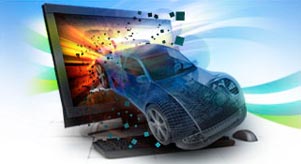 The approach is good. It does not talk down to people. It assumes they are intelligent. For people who had not grasped the idea of 3D laser scanning before, this video makes 3D laser scanning technology non-threatening. More importantly, it unfolds the potential usefulness of the technology in digestible chunks.
I confess that the last few minutes of the presentation speak about Konica Minolta's new Range 7 scanner. But for those of you who know something about 3D laser scanning, this very brief section of the presentation could be its most interesting. It goes into techno speak about accuracy, scanning, speed, and how the Range 7 is really good at scanning glossy surfaces and metals without you having to spray something all over it. If you're in the market for the first time or to upgrade, you'll want to check out that part of the video.
All in all, Konica Minolta's 3D laser scanning video is a good tool for you to leverage so that you can explain to the keeper of the checkbook the potential 3D laser scanning holds for your company. You can check out it here.
Thanks, Pal — Lockwood
Anthony J. Lockwood
Editor at Large, Desktop Engineering Magazine


Anthony J. Lockwood is Digital Engineering's founding editor. He is now retired. Contact him via [email protected].
Follow DE






About Us · Contact Us · Editorial Team · Advertising · Privacy Policy · Subscriber Services · © 2026 Digital Engineering 24/7 · Peerless Media