Helping design and engineering professionals discover, evaluate and specify technologies and processes that shorten the design cycle and enable success.



Digital Engineering April 2026
In the latest issue of Digital Engineering, we take a look at the latest innovations in design for additive manufacturing, including the use of natural language inputs, social media cosplayers, and AI integration. The issue also includes a feature…

January Special Focus Issue: Design for Additive
In this Special Focus Issue of Digital Engineering, learn about the latest advancements in design for additive manufacturing, including new software tools, additive in automotive, custom medical devices, and more.
Contour crafting uses a crane-mounted deposition head that extrudes a cement-based paste against a trowel one layer at a time to deliver a smooth finish. This particular technique has been worked on the longest, and can currently produce a structure-bearing cement wall with minimal material waste. Contour crafting also allows for the inclusion of necessary structural elements (wiring, plumbing, etc.) during the process.
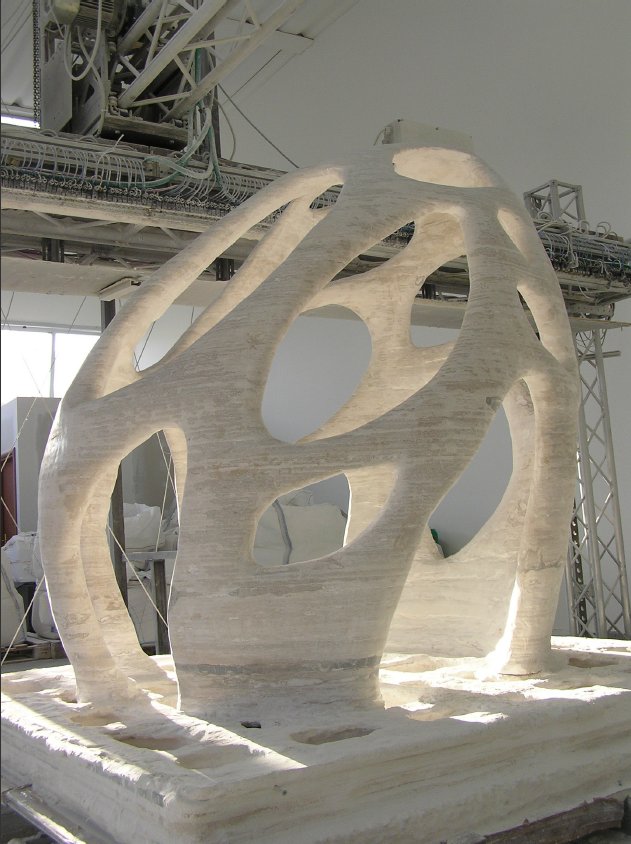
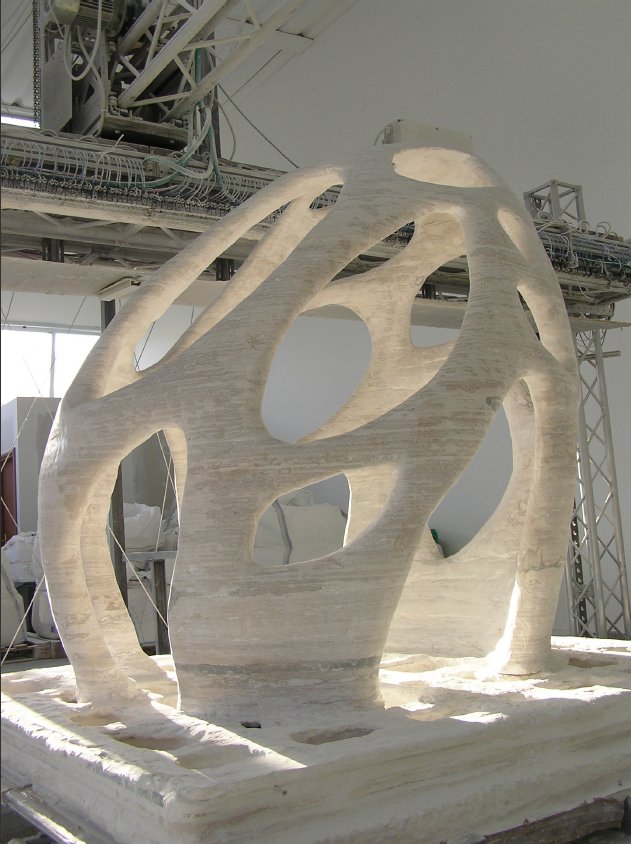
The process, called D-Shape, implements powder deposition to create structures in much the same way as many standard AM machines. Each layer is built at a specified thickness and is then compacted. As a layer is deposited, it is partially hardened using a binder. A completed piece is then dug out of the loose powder and cleaned up before use.
Concrete printing uses a similar process as contour crafting, but allows for greater control of deposition. Each layer is thinner and can be used to create structures with complex internal and external shapes. It could be thought that contour crafting is best for quick creation of building materials, while concrete printing allows for more architectural freedom in design.
Below you’ll find a short video that discusses this large-scale use of AM.
Source: Automation in Construction


John Newman is a Digital Engineering contributor who focuses on 3D printing. Contact him via [email protected] and read his posts on Rapid Ready Technology.
Follow DE
Join over 90,000 engineering professionals who get fresh engineering news as soon as it is published.






About Us · Contact Us · Editorial Team · Advertising · Privacy Policy · Subscriber Services · © 2026 Digital Engineering 24/7 · Peerless Media