Helping design and engineering professionals discover, evaluate and specify technologies and processes that shorten the design cycle and enable success.



Digital Engineering April 2026
In the latest issue of Digital Engineering, we take a look at the latest innovations in design for additive manufacturing, including the use of natural language inputs, social media cosplayers, and AI integration. The issue also includes a feature…

January Special Focus Issue: Design for Additive
In this Special Focus Issue of Digital Engineering, learn about the latest advancements in design for additive manufacturing, including new software tools, additive in automotive, custom medical devices, and more.
This sort of reluctance is one of the reasons why many new ideas come from students or recent graduates. Rather than just accepting the reasoning of, “This is how we’ve always done it,” someone with a fresh perspective is better capable of thinking outside the box. Students at the University of Bayreuth have proven this idea with their novel use of a sand mold.
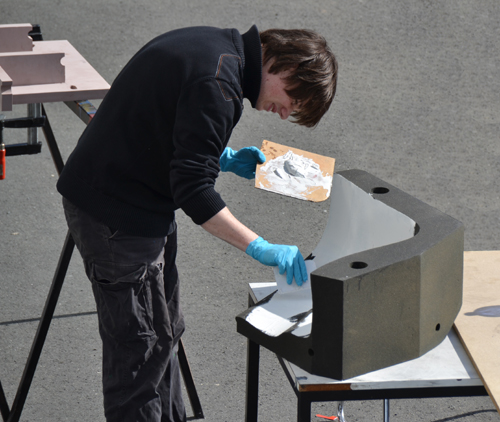
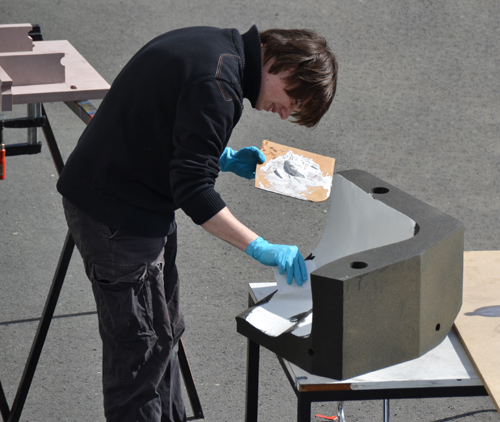
The core, built for the students by voxeljet, was created to fabricate a new seat for the university’s Elefant Racing team’s car. While the seat design already has some thought behind it, the racing team was eager to create a prototype to further tweak the details. Elefant Racing used the mold to make a laminate template.
"The positive mold gives us the option of 'test-sitting' the new seat before laminating, and to make adjustments if necessary,” said Artur Horn, team manager. “A sand mold is ideally suited for this purpose, since it can be easily machined with sanding and scraping. However, the current mold from the voxeljet printer was a perfect fit from the start."
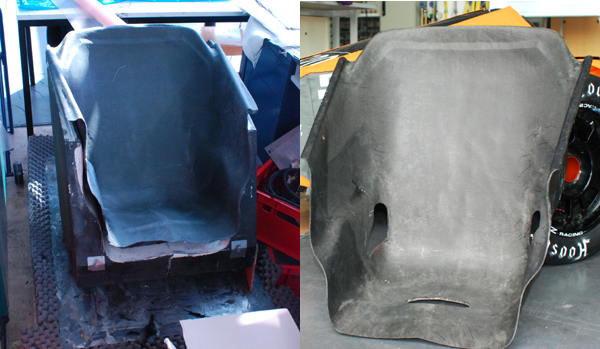
The seat mold was printed at voxeljet to the design specs of the team in the form of several individual components, which were subsequently assembled. During the laminating process, carbon fiber mats were placed over the printed mold and coated with epoxy resin. This process was repeated until the desired material thickness had been achieved. Finally, the seat was put in a vacuum-packed plastic bag and cured at room temperature.
"We have been supporting the Elefant Racing team for some time, and we never cease to be amazed by the students' creativity, which continues to open up new areas of application for 3D printing technology,” said voxeljet CEO Dr. Ingo Ederer. “We wish the team much success with the new seat, and a successful racing season.”
Below you’ll find a video about voxeljet’s large-scale sand printer, the VX4000.
Source: voxeljet


John Newman is a Digital Engineering contributor who focuses on 3D printing. Contact him via [email protected] and read his posts on Rapid Ready Technology.
Follow DE
Join over 90,000 engineering professionals who get fresh engineering news as soon as it is published.






About Us · Contact Us · Editorial Team · Advertising · Privacy Policy · Subscriber Services · © 2026 Digital Engineering 24/7 · Peerless Media