Helping design and engineering professionals discover, evaluate and specify technologies and processes that shorten the design cycle and enable success.


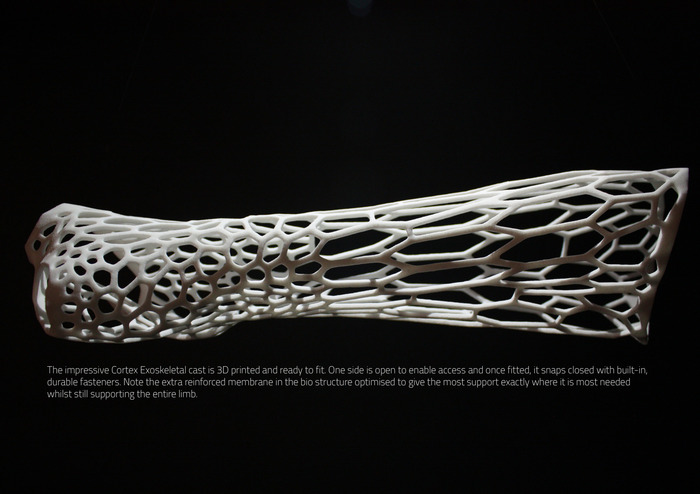

Digital Engineering April 2026
In the latest issue of Digital Engineering, we take a look at the latest innovations in design for additive manufacturing, including the use of natural language inputs, social media cosplayers, and AI integration. The issue also includes a feature…

January Special Focus Issue: Design for Additive
In this Special Focus Issue of Digital Engineering, learn about the latest advancements in design for additive manufacturing, including new software tools, additive in automotive, custom medical devices, and more.
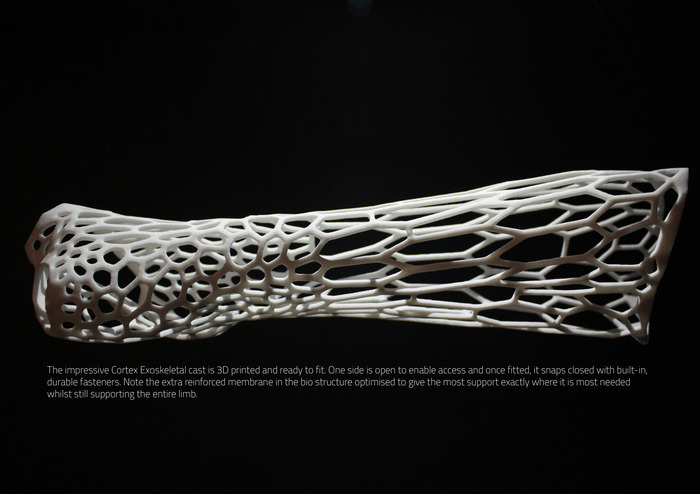
Like many other items, the future of the cast may well be shaped by additive manufacturing (AM). The Cortex is an idea hatched by Jake Evill (maybe the best name ever if he goes for a doctorate) that uses 3D printing to form an exoskeleton around breaks. The Cortex is lighter than traditional casts and, best of all, has enough holes in it that you could actually scratch beneath it without fear of injuring yourself with something pointy.
From Evill’s web page:
After many centuries of splints and cumbersome plaster casts that have been the itchy and smelly bane of millions of children, adults and the aged alike, the world over, we at last bring fracture support into the 21st century. The Cortex exoskeletal cast provides a highly technical and trauma zone localized support system that is fully ventilated, super light, shower friendly, hygienic, recyclable and stylish.
Fitting the Cortex to a patient uses an X-ray to determine the exact location of the break, followed by a 3D scan of the limb in question. Information from the X-ray and scan are fed into a computer, which crunches the data to determine the best possible structural design for the Cortex to provide support for the break. A 3D printer then builds the über-cast, complete with built-in fasteners.
Not only would the Cortex be lighter and less annoying to wear, shaping each cast to a specific patient would reduce medical waste. The slimmer design would more easily fit under clothing, and doctors could even add some flourishes to the cast for those inclined to fashion.
Sadly, I can’t find a video related to the Cortex, so below you’ll find a clip about how 3D printing helped build Iron Man’s suit. I’m sure the suit keeps Tony Stark from breaking something.
Sources: SlashGear, Jake Evill


John Newman is a Digital Engineering contributor who focuses on 3D printing. Contact him via [email protected] and read his posts on Rapid Ready Technology.
Follow DE
Join over 90,000 engineering professionals who get fresh engineering news as soon as it is published.






About Us · Contact Us · Editorial Team · Advertising · Privacy Policy · Subscriber Services · © 2026 Digital Engineering 24/7 · Peerless Media