Helping design and engineering professionals discover, evaluate and specify technologies and processes that shorten the design cycle and enable success.



Digital Engineering April 2026
In the latest issue of Digital Engineering, we take a look at the latest innovations in design for additive manufacturing, including the use of natural language inputs, social media cosplayers, and AI integration. The issue also includes a feature…

January Special Focus Issue: Design for Additive
In this Special Focus Issue of Digital Engineering, learn about the latest advancements in design for additive manufacturing, including new software tools, additive in automotive, custom medical devices, and more.
Brian Harms, a design research Masters Student at the Southern California Institute of Architecture (SCI-Arc) has advanced a new AM process he calls suspended deposition. In its current state, suspended deposition employs a robotic arm and liquid resin to build 3D objects in a tank of gel.
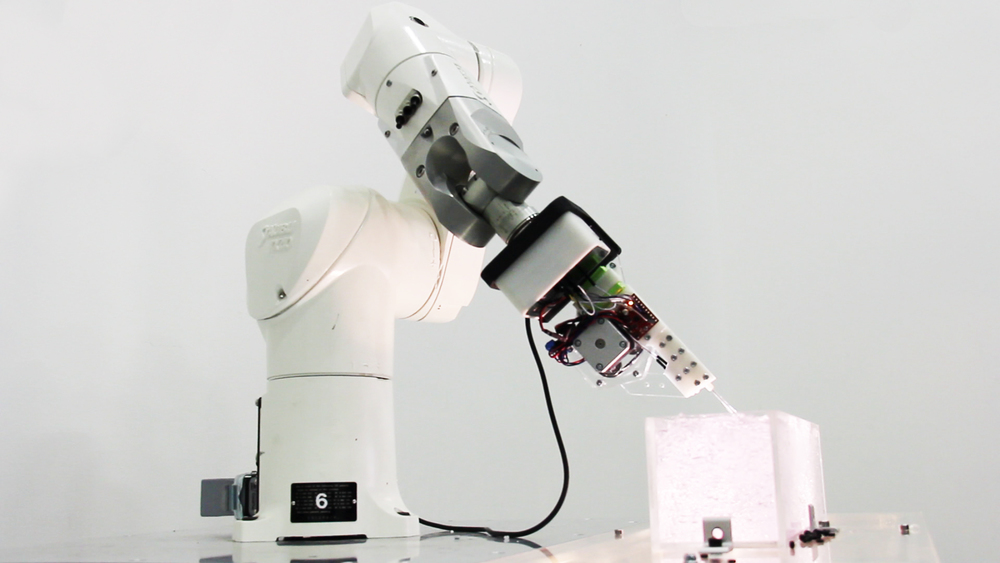
The gel acts as a support material for builds, allowing objects to be built with a light-curing resin material. Working in this manner allows for builds to proceed in three dimensions, rather than ending in a 3D object. Different parts of an object can be built up before returning to the base and working on a separate area, and alterations in the design can be achieved by adding to “finished” portions of the object during the same build.
One major distinction between this project and other rapid prototyping processes is the ability to utilize 3D vector-based toolpaths. Virtually all other processes use paths generated via contouring a digital model, and rely on the hardening of each successive layer before being able to move on to the next. –Brian Harms
In addition to building in three dimensions, the nature of the light-curing resin suspended in gel allows for subtractive methods. This amounts almost to an undo feature. If an area of a build needs to be altered or reconstructed due to an error, the resin can basically be scooped out before it hardens and replaced with a new shape.
Using a robotic arm to for AM isn’t the most cost-effective method of printing objects, but it probably wouldn’t require much effort to adapt Harm’s suspended deposition process to more standard forms of 3D printing. The power to save a build with one or more errors by simply undoing the problem areas might be nearly worth its weight in gold just to save on material waste.
Below you’ll find a video of the process.
Source: NSTRMNT


John Newman is a Digital Engineering contributor who focuses on 3D printing. Contact him via [email protected] and read his posts on Rapid Ready Technology.
Follow DE
Join over 90,000 engineering professionals who get fresh engineering news as soon as it is published.






About Us · Contact Us · Editorial Team · Advertising · Privacy Policy · Subscriber Services · © 2026 Digital Engineering 24/7 · Peerless Media