Helping design and engineering professionals discover, evaluate and specify technologies and processes that shorten the design cycle and enable success.


Alert!
Digital Engineering ceased publication on July 1, 2026. This website remains available as an archive of engineering content.
For inquiries or information, please email [email protected].

Digital Engineering April 2026
In the latest issue of Digital Engineering, we take a look at the latest innovations in design for additive manufacturing, including the use of natural language inputs, social media cosplayers, and AI integration. The issue also includes a feature…

January Special Focus Issue: Design for Additive
In this Special Focus Issue of Digital Engineering, learn about the latest advancements in design for additive manufacturing, including new software tools, additive in automotive, custom medical devices, and more.
 The ESA printed bricks from simulated moon dust using a solar furnace. Image: ESA
Space colonization enthusiasts will be thrilled to know that at least two different research teams have made progress on 3D printing technologies that will allow space travelers to create tools and building materials on the surface of the moon and Mars.
The European Space Agency (ESA) has printed bricks using simulated moon dust and concentrated sunlight. The process could help moon colonists use lunar materials to build new settlements.
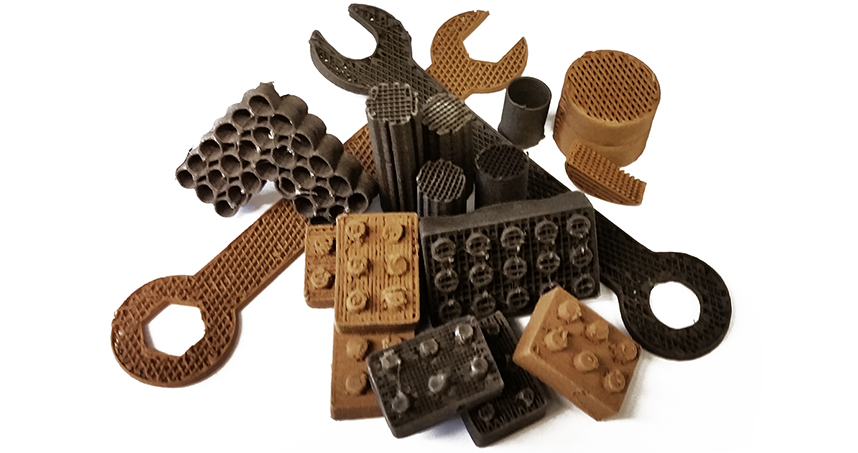
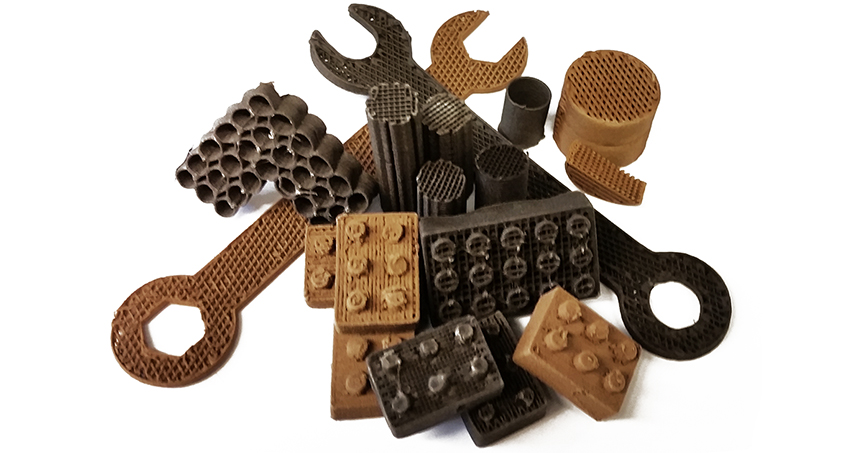 Northwestern researchers printed tools and Lego-like building blocks from simulated lunar and Martian dust. Image: Northwest
“We took simulated lunar material and cooked it in a solar furnace,” explains materials engineer Advenit Makaya, overseeing the project for ESA. “This was done on a 3D printer table, to bake successive 0.1 mm layers of moon dust at 1000°C. We can complete a 20x10x3cm brick for building in around five hours.”
The test used commercially available simulated lunar soil that was baked in the solar furnace at DLR German Aerospace Center in Cologne. The bricks are roughly as strong as gypsum and will be subjected to mechanical testing.
The ESA test the process in simulated lunar conditions (vacuum and high-temperature extremes) as part of the RegoLight project.
The Tissue Engineering and Additive Manufacturing (TEAM) Laboratory at Northwestern Engineering have also demonstrated 3D printing using simulated lunar and Martian dust.
“For places like other planets and moons, where resources are limited, people would need to use what is available on that planet in order to live,” said Ramille Shah, assistant professor of materials science and engineering at Northwestern’s McCormick School of Engineering and of surgery in the Feinberg School of Medicine. “Our 3D paints really open up the ability to print different functional or structural objects to make habitats beyond Earth.”
The team created “paints” out of dust simulants combined with simple solvents and biopolymer. The material was printed using an extrusion process.
The resulting objects were more than 90% dust by weight but were as durable and flexible as rubber. The material can be cut, rolled or folded after being printed. You can access the paper and findings here.
Source: ESA and Northwestern


Brian Albright is the editorial director of Digital Engineering.
Contact him at [email protected].






About Us · Contact Us · Editorial Team · Advertising · Privacy Policy · Subscriber Services · © 2026 Digital Engineering 24/7 · Peerless Media