Helping design and engineering professionals discover, evaluate and specify technologies and processes that shorten the design cycle and enable success.


Alert!
Digital Engineering ceased publication on July 1, 2026. This website remains available as an archive of engineering content.
For inquiries or information, please email [email protected].

Digital Engineering April 2026
In the latest issue of Digital Engineering, we take a look at the latest innovations in design for additive manufacturing, including the use of natural language inputs, social media cosplayers, and AI integration. The issue also includes a feature…

January Special Focus Issue: Design for Additive
In this Special Focus Issue of Digital Engineering, learn about the latest advancements in design for additive manufacturing, including new software tools, additive in automotive, custom medical devices, and more.
“NIAR has been commissioned to develop the framework that would include polymer additive manufacturing under the NCAMP umbrella,” said Paul Jonas, director of technology development, Special Programs, Wichita State University, in a press statement provided by Stratasys. “The first part that you make has to be equivalent to the hundredth part, to the thousandth part, to the part you make 10 years from now in order to be good enough to be certified for the FAA. And that’s what’s so powerful about the NCAMP process.”
The basis of the Aircraft Interiors Certification Solution is Stratasys' Certified ULTEM 9085 resin 3D printed by a new version of the Fortus 900mc Production 3D Printer, the company's largest-capacity FDM (fused deposition modeling) additive manufacturing system. This new Fortus 900mc configuration features specialized hardware and software to deliver highly repeatable mechanical properties, according to the company. Among the other components of the solution are new model and support tips (T16A) and an Equivalency Toolkit to calibrate and validate the Fortus 900mc's operation and accompanying process control documents with instructions to carry out the calibration and validation procedure.
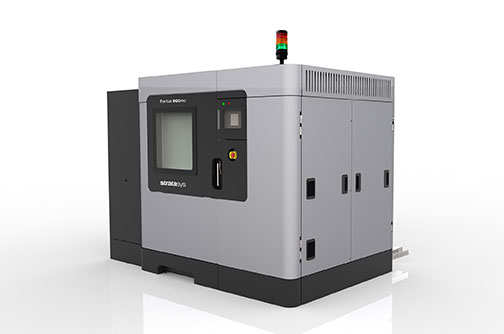 The Stratasys Aircraft Interiors Certification Solution for 3D printing aircraft interior parts that meet aviation certification requirements features a new configuration of the Fortus 900mc Production 3D Printer with specialized hardware and software to deliver highly repeatable mechanical properties. Image courtesy of Stratasys Ltd.
Certified ULTEM 9085 resin is a strong, lightweight thermoplastic that meets aerospace flame, smoke and toxicity (FST) regulations (FAR 25.863), according to Stratasys. It differs from standard ULTEM 9085 in that Certified ULTEM 9085 filament is produced in smaller batches, receives more frequent testing and is accompanied by additional documentation, explains Stratasys. Documentation includes a material specification governing the production of Certified ULTEM 9085 filament as well as a process specification for using the material to build parts on the Fortus 900mc. A design allowables dataset (NCAMP-approved B-Basis) documents the material properties of Certified ULTEM 9085 when printed with the Aircraft Interiors edition of the Fortus 900mc.
The new Stratasys Aircraft Interiors Certification Solution also provides material and process traceability for compliance with major global airworthiness regulations. The qualification test program now under way is expected to be completed by September 2017, with publication of the final NCAMP qualification report to follow.
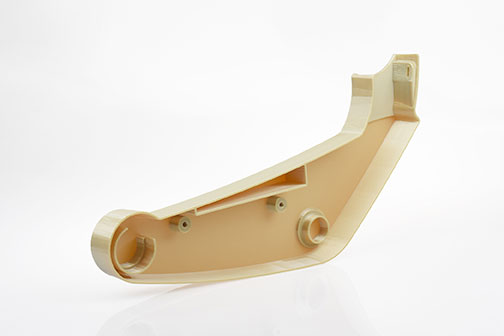
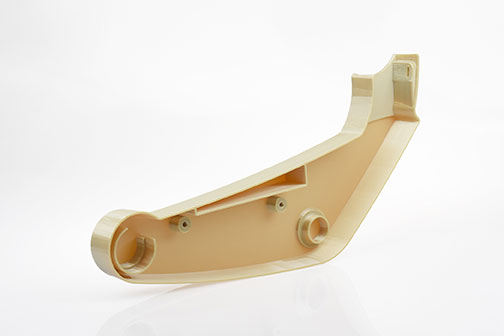 A Stratasys Fortus 900mc 3D printed this armrest component with Certified ULTEM 9085, a strong, lightweight thermoplastic that meets aircraft flame, smoke and toxicity regulations. Image courtesy of Stratasys Ltd.
“Until now, the process of achieving FAA certification for 3D printing has been limiting the adoption of additive manufacturing in aviation. There have been limited specialized solutions and statistical datasets available to support this complex process,” said Scott Sevcik, head of Aerospace, Defense and Automotive Solutions, Stratasys, in a press statement. “With the new Stratasys Fortus 900mc Aircraft Interiors Certification Solution, we are removing major obstacles and making it much easier to 3D print airworthy parts, improving repeatability and performance.”
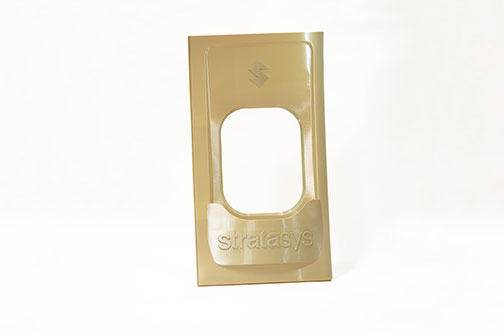 This aircraft interior window panel was 3D printed using Certified ULTEM 9085 resin on a new edition of the Fortus 900mc Production 3D Printer, Stratasys' largest-capacity FDM (fused deposition modeling) additive manufacturing system. Image courtesy of Stratasys Ltd.
The Fortus 900mc Aircraft Interiors Certification Solution is available for pre-order and will be widely released at the conclusion of the test program, according to Stratasys. Stratasys will assist customers in qualifying their Fortus 900mc Aircraft Interiors Certification Solution for equivalency with the NCAMP statistical dataset. Current users of the Fortus 900mc Production 3D Printer interested in the Aircraft Interiors Certification Solution can purchase a system upgrade, which also includes material and documentation support, according to the company.
For more information on the Stratasys Aircraft Interiors Certification Solution, click here.
Download the Aircraft Interiors Certification Solution brochure.
Download the ULTEM 9085 brochure.
Download the Aircraft Interiors Certification Solution Guide.
See why DE's editors selected the Fortus 900mc Aircraft Interiors Certification Solution as their Pick of the Week.
Sources: Press materials received from the company and additional information gleaned from the company's website.


Anthony J. Lockwood is Digital Engineering's founding editor. He is now retired. Contact him via [email protected].
Follow DE
Join over 90,000 engineering professionals who get fresh engineering news as soon as it is published.






About Us · Contact Us · Editorial Team · Advertising · Privacy Policy · Subscriber Services · © 2026 Digital Engineering 24/7 · Peerless Media